


A woman in my circle spends her working life on call for other people.
When a client might need her that night, she runs a checklist:
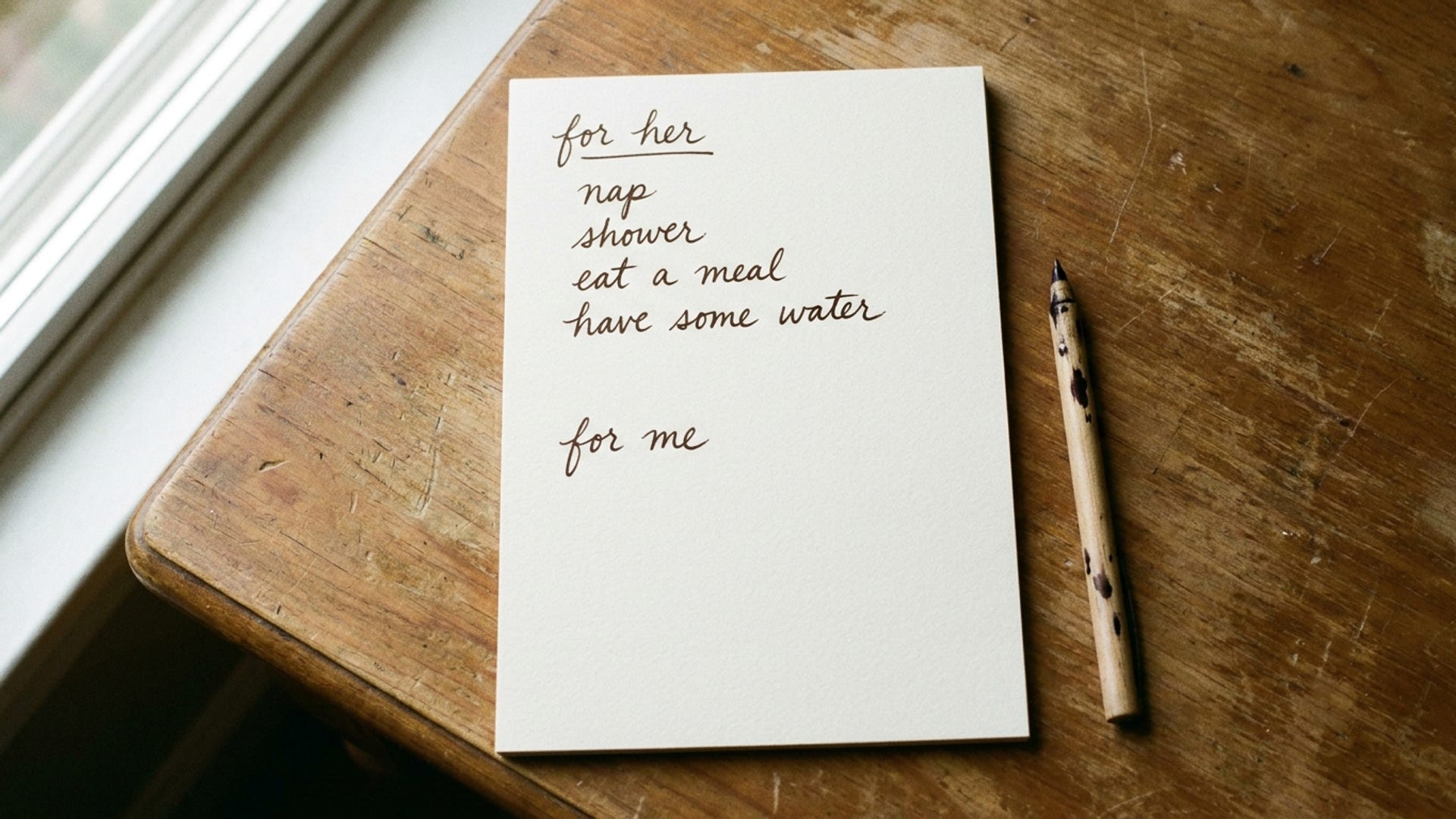
I might ask myself, what do I need to do to be ready for my client? Do I need to nap, shower, eat a meal, have some water?
Then she wrote:
[I’m] not as likely to slow down and ask myself, what do I need for me in this moment? To be ready to meet me?
Same woman, same body, same tired afternoon.
For a client, the answer comes fast.
But for herself, the question barely gets asked.
In a voice note, she said:
I negotiate with myself all the time.
The meeting that never adjourns
Many of us are familiar with that negotiation, even if we’ve never called it that.
It runs underneath the day like a radio left on in another room.
I’m hungry. Have I done enough to eat yet?
Did I earn a break, or do I still owe the morning?
Will someone need me in 45 minutes?
Is this tiredness real, or am I being dramatic?
Each question sounds reasonable, and each takes a mere second to answer. That’s the trap. Because it’s quick, it never feels like it costs anything. So it never gets settled.
You can finish a task, send the email, make the call, and fold the laundry. But you can’t finish deciding whether you’re allowed to stop. The question comes back to you at noon, again at 3, and again at 9 when the house goes quiet and you decide this is finally your time to catch up on whatever’s left over.
“True about abandoning myself in the afternoon and into evening,” she wrote.
And she articulates what’s at the table doing the bargaining:
“Gripping a rule/s about what I need to accomplish in a day to feel what — successful? Done? Valuable?”
That’s what she’s negotiating with: a rule about what a worthy day looks like, written a long time ago. Most of us never noticed we agreed to it.
Where I learned to negotiate
I learned young.
In my tweens: unless it was assigned in school, my parents discouraged me from reading fiction because I should be learning. I should choose autobiographies and history. Enjoyment wasn’t learning. It wasn’t productive.
In high school: I loved French. The way the liaisons connected the words and sentences together made the language sound so beautiful to me. But I chose Spanish because the adults told me it was the practical choice. My parents would have wanted me to take Korean but that wasn’t offered, so Spanish it was.
Each choice looked sensible on its own.
What I didn’t see was the habit forming underneath it.
When what I wanted and what “made sense” disagreed, what made sense won, because everyone said that was responsible.
I didn’t believe them. But I chose as if I did.
So I started arguing with myself instead of with them.
The same negotiation showed up later, in rooms with trainers who pushed me to sell the financial products with the highest commissions instead of what was best for the client. I was in my early 20s navigating between what I knew inside and what the successful people around me “knew.” It put me off. When a well-known respected financial company pushed me to go after the elderly market, I quit.
Then my cleaning products made it onto the shelves at Whole Foods.
At the time, mine was the only product there with a third-party rating of green across the board. The ones sitting next to me scored orange or red.
The “experts” told me that, in order to grow, I had to use cheaper ingredients, and instead of calling my spray an “all purpose cleaner,” I should split the same product into a “kitchen counter cleaner,” a “floor cleaner,” and so on. Because people don’t know what to do with all purpose. I’d sell more products.
I felt offended. I wanted people to buy less, and the best quality. I didn’t know what to do with this “conflict.”
It took me a long time to recover from “sales and marketing.”
My compass never. stopped. pointing. I just kept arguing with it.
Some people believe those rules completely. They don’t feel the conflict, sometimes not until midlife, when they look up and realize they’ve been living someone else’s dream.
I, however, felt it the whole time, and that was the negotiation.
These were the places where it showed up, between what I knew to be true for me and what others said should happen. There shouldn’t have been any negotiation. Just me, listening to what I knew and making those choices.
The arguing wore me out more than the work ever did.
Settle it before noon
After years of watching this, in myself and in the women I work with, here’s what I believe: you don’t win the negotiation by arguing better. You win it by having fewer of them.
That’s the job of the anchors.
A warm, sit-down lunch, without multitasking, at the same time each day, is a decision you make once, so you aren’t litigating it at 12:15 with the inbox open.
The morning practice works the same way. When it happens at the same time, especially with the same people, you don’t have to talk yourself into it. The appointment already took care of that.
The 3pm and 9pm checks are short questions with no bargaining in them. Just: what’s my body reporting right now?
These anchors are decision points. They give us a different answer to the small betrayals of the past that snowballed into constant negotiating with ourselves. Choosing non-fiction over fiction. Choosing the more “practical” over what lights us up. Throwing down cold leftovers over the laptop because we haven’t earned that time yet.
Discipline would mean winning the argument every day.
The anchors end the argument, period.
We stop asking whether we get to have lunch because it was already decided.
The woman in the circle said it plainly: “it helps tremendously if underlying all of it, I’m taking good care of myself - food, sleep, movement, and learning to do less negotiation and self abandonment.”
Back to the checklist
Back to her checklist: nap, shower, eat a meal, have some water.
She already knows exactly what a body needs to be ready.
She runs it beautifully for someone else.
The question she’s practicing now is the second one:
What do I need for me in this moment? To be ready to meet me?
You probably know your answers too. Most of us do.
The practice is in asking the question for yourself before noon, before the negotiation starts.
Eat warm, breathe slow, keep a rhythm.
— Savitree
If we take the time to notice, there are simple messages that transfer to and can be applied to other elements of our lives. The one I always think of is when flying - If you’re told to put on your life jacket, put yours on before helping anyone else with theirs. Unless you look after yourself first you’re in no position to effectively help someone else, even if you think you are. 🤔