


You’ve read the productivity advice.
You know you should “eat the frog” and tackle the hard thing first.
So why does 2pm find you reorganizing your inbox instead of working on the project that actually matters?
You may think: I just don’t have the discipline.
Last week I wrote about the clarity threat: how fog can become a strategy for avoiding the scary work, and how the grind can protect you from finding out what happens when you actually try.
This week, I want to test something much more concrete: Lunch.
By 2 or 3pm, your cognitive budget may feel very different than it did at 9am.
A lot can contribute to that shift: sleep, workload, stress, health, hormones, hunger, decisions, interruptions.
Lunch is one of the first variables I look at because it gives us something specific to change and observe.
Timing. Enough food. Pace. Warmth. Whether you stopped long enough to actually eat instead of carrying the morning straight through the meal.
Those are concrete variables.
Change them and watch what happens at 3pm.
That gives us something more useful than another rule.
It gives us your data.
Your afternoon brain has a different budget
You probably already know the feeling.
After a morning of decisions, interruptions, and context-switching, the important work can start feeling heavier.
Easy tasks become more attractive.
Your patience gets shorter.
You start negotiating with things you were clear about three hours ago.
I use lunch because it gives us something specific to test in the middle of the day.
What time did you eat?
Was it enough?
Were you sitting or moving?
Were you eating or answering email?
Was the meal warm or cold?
And what did 3pm feel like afterward?
Three lunch variables worth testing
1. Timing
Eat before you’re already depleted and desperate for whatever is fastest.
2. Pace
Sit down. Put the screen away. Give the meal enough attention that you can actually notice what happens afterward.
3. Warmth
Ayurveda has long treated warm, cooked food as supportive to digestion. It’s also the lunch practice I’ve used and taught for years.
I want you to test it rather than accept it because I said so.
Eat warm for several days. Read your 3pm. Compare.
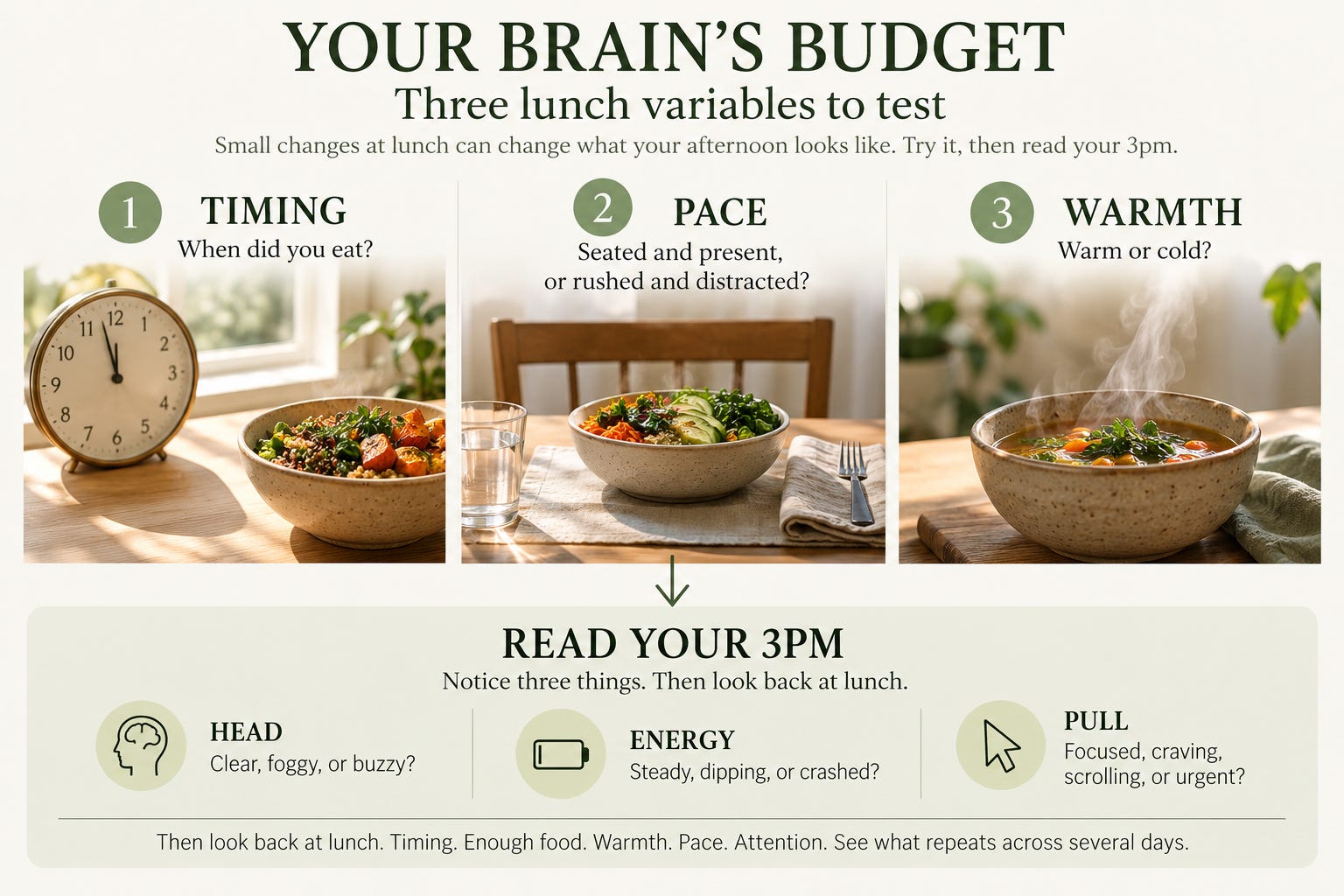
Want to test this today?
At 3pm, notice three things: your head, your energy, and what you’re pulled toward.
Then look back at lunch.
Timing. Enough food. Warmth. Pace. Attention.
See what repeats across several days.
This is about whether you get to do the work you came here to do
You don’t need a longer to-do list.
You need to pay attention to what your cognitive budget looks like by afternoon.
Lunch is one place to test what changes it.
Protect one lunch and see what changes.
Eat before the afternoon is already falling apart.
Sit down.
Give the meal your attention.
Try it warm.
Then read your 3pm.
You’re building a relationship between what you do and what you notice afterward. That’s signal literacy.
The compound effect:
Maybe your 3pm gets steadier.
Maybe your 4pm decisions look more like the intentions you had at 9am.
Maybe you reach the end of the workday with more capacity for the thing that actually matters.
Watch for it.
That’s the experiment.
The project that matters to you needs more than whatever capacity happens to be left at 4pm.
Start with lunch.
Choose one lunch variable test.
Read what happens next.
And if you want to see how lunch fits into the rest of your day, take the Day in the Life Diagnostic. Your lunch is one data point. Let’s look at the whole pattern.
Eat warm, breathe slow, keep a rhythm.
— Savitree
The Four Anchors
Anchor 1: The Wake-Up Stack
Anchor 2: Your brain’s budget: how lunch can shape your afternoon decisions (this essay)
Anchor 3: The Energy Audit: why your 3pm tells the truth
Anchor 4: The 9pm Scan: how tonight can shape tomorrow morning
More on lunch: Your body’s boardroom: the meeting you keep skipping
Interesting article. Curious your thoughts on intermittent fasting. I’ve noticed that my blood sugar being stable keeps me from having an “afternoon crash” whether I eat or not. Also interested if you’ve looked at creatine’s impact on preventing an afternoon crash.
Great article! Thank you for taking your time to write it! Helpful piece ❤️