


Carol’s morning starts with dread.
She loves her work, it’s creative. But she dilly-dallies getting to it while simultaneously feeling behind. Her mind doesn’t stop. She’s thinking about what needs to get done today and who needs to get picked up when.
When she gets hungry, she can’t wait to eat, but then rushes through lunch like she can’t wait to finish. When she’s done, a part of her wants a redo; the food was good, but she didn’t get to enjoy it. So cravings ping all afternoon, and she’s learned to keep little bags of cashews, dates, and lentil chips close by.
By evening, she’s wired-tired instead of relaxed-tired.
Her mind fights her body’s desire to rest.
Or, her body’s nervous energy fighs with her mind that knows she should rest.
Either way, she’s unable to turn off her to-do mode.
She gets up multiple times to write reminder notes and get another thing ready for tomorrow. She thinks about how much she’s crossed off her list, and also the things that never get crossed off: her plans. Delayed yet again.
Unable to sleep, and with the rest of the house in bed, she decides it’s “me time” and quietly gets to work in the darkness.

She wakes up tired and with dread. The cycle continues.
She’s tried everything: the apps, the routines, the morning rituals she read about. Nothing sticks… or they stick for a week and then life happens.
This is just how it is. How she is. A night owl. Someone who works better under pressure. Someone who needs the chaos to function.
Except on some nights, when the house is quiet and she’s alone with the screen, a thought surfaces: Is this it?
Here’s the thing:
Carol isn’t lazy.
She’s not scrolling all day. She crosses a lot off her list by lunchtime.
And she shows up for everyone.
By most measures, she’s productive.
So why the dread? Why the emptiness?
She’s doing the work. Just not her work.
Most people think it’s a consistency issue. Or a focus issue.
I’ve worked with people who excel at both and still wake up with dread.
One of these clients made seven figures in commercial real estate. He was grounded, focused, intentional, generous, and well-liked. He’d built stability most people dream about.
One morning he said, “Fuck, is this it?”
Not because he wanted more; he didn’t feel that kind of lack.
What he hadn’t realized was that he had borrowed his father’s priorities.
His father ruined holidays over money stress. My client swore that wouldn’t be him. So he built wealth. Discipline. Security. Everything his father couldn’t.
And it was hollow. Because the goal was never his.
Grind Work isn’t always busywork. It isn’t always scattered.
Sometimes it looks like discipline. Sometimes it builds empires.
But Grind Work is work that isn’t yours. It’s borrowed.
How do you know if it’s borrowed?
Your body tells you: Dread in the morning. Emptiness at night. Snoozing the alarm, or setting it early enough so you can snooze it a few more times. Wired-tired instead of relaxed-tired. Craving something after lunch you can’t name.
The body knows before the mind figures it out.
Deep Work is different. It’s not harder or necessarily more focused.
Deep Work is owned.
It brings a different urgency. Not of catching up, or of proving yourself, but of living. Of finding your edge and building something that’s actually yours.
The question is: which are you running?
The “gift” moments:
You family leaves town, and your afternoon opens up.
Finally, you get to sit down and start the thing that never gets crossed off.
Laptop opens. But wait, something’s missing.
You make yourself a chai latte and plate some fruit to have at your desk.
As you sip, you see that your folders don’t make sense, and you reorganize them to feng shui your mind.
To borrow some clarity, you watch a YouTube tutorial that took a bit longer than you hoped to spend.
That course you bought a year ago might hold something, so you look to see where you left off and what sticks out that might help you today.
Finally, something happens.
Fingers are on the keys, and you’re typing into a Google doc. Is this flow happening?
Then the phone rings.
It’s your person, and you take the call.
You lose your thread.
And you remember you haven’t seen the next episode of that show that left you hanging. Take a break to watch it? No, that’s a trap.
Let’s run that errand instead. Fresh air, cross something off.
You run into an old friend, you talk, and you get the high of connection.
Home. Errands crossed off. Talked to your person. Saw a friend.
Good afternoon. The dream can wait.
This too is your dream, right?
Family, friends, not worried about where the next meal is coming from.
But you’re exhausted in a way you can’t pinpoint.
Everything’s fine. But not really.
Myth: the grind is blocking your dream.
Truth: the grind is protecting your dream from reality.
As long as it stays in the “someday” folder, it can’t fail. It lives in unlimited possibility.
The moment you claim the time, produce the thing, and put it out there, possibility becomes specific. And specific can be judged.
So you defer.
A woman once told me, “I’ve surrendered to the fact that I just have to wait for my children to move out to start my life.”
Her youngest was 5.
Not 17. Five.
Thirteen years of waiting for permission that was always hers to claim.
I have a real question for you.
If you had to date the part of you that shows up for you — not the way you show up for others, but the way you show up for yourself — would you date you?
The part that keeps renegotiating, postponing, and saying “after this” and “when things settle down.”
The part that, even when she’s there, is mentally in the next ten things. Picking up calls. Losing her own thoughts because she won’t give herself the attention she deserves.
Would you date her?
The women I ask say: hell no!
They’d ghost themselves inside a week.
So why do we keep doing it?
One client was late to everything. She said it couldn’t be helped, it’s just who she is.
I asked if she ever misses her plane.
No. Never.
So it can be helped. She just doesn’t treat her own time like a flight departure.
The difference is deciding: stolen time or owned time.
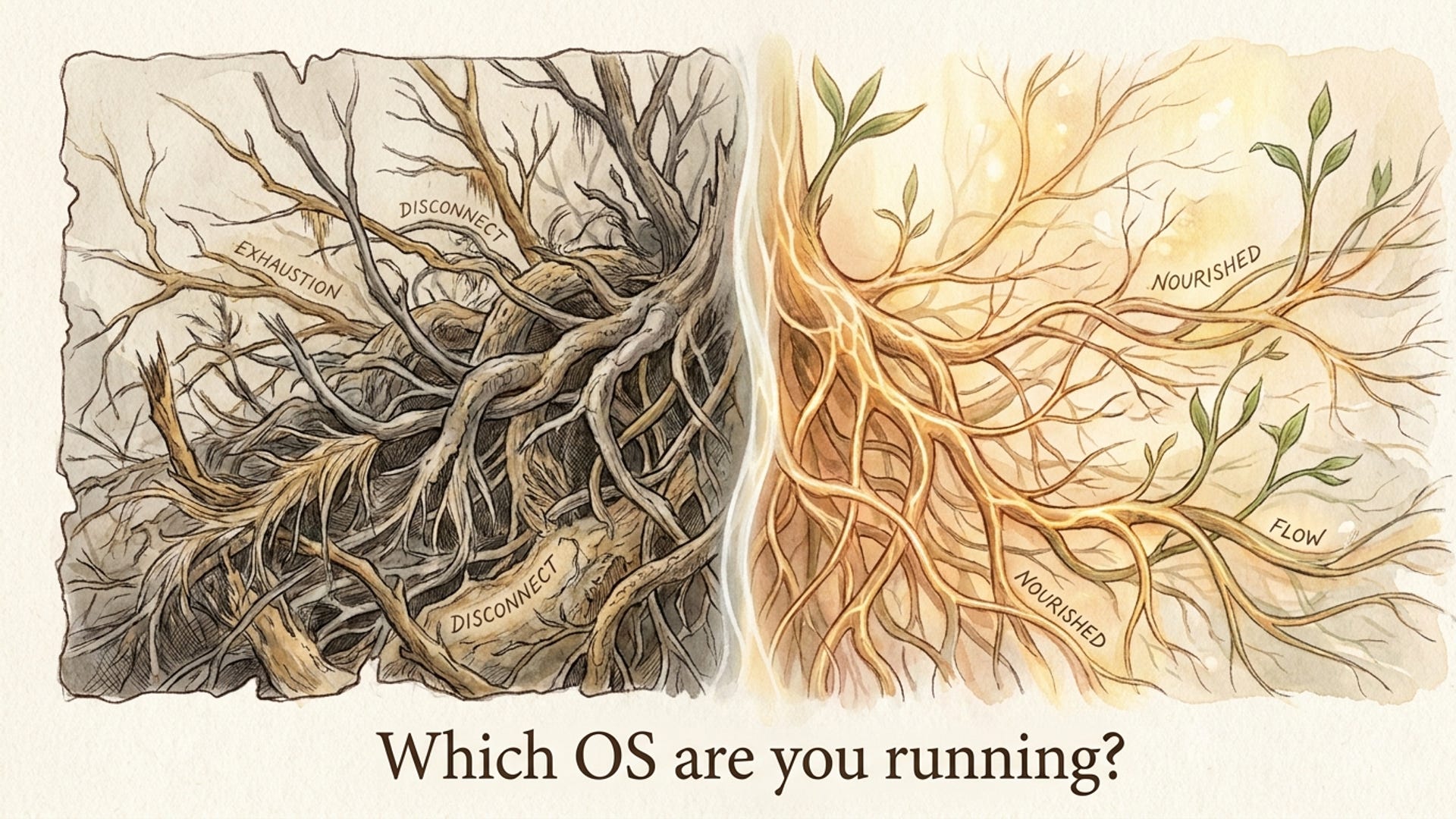
The To-Do OS, where external forces rule your urgency.
Or the Exhaustion-Proof OS, where you own it.
The upgrade in your internal operating system won’t feel easy because it feels stressful at first.
But it’s clean stress. The kind that takes you one step closer to your owned life each time you choose it.
Not the dirty kind that leaves you wired at midnight, wondering if this is it.
Marie wakes up rested and present. Her mind isn’t all over the place, nor is her body reaching for the phone.
Her calendar is full, but there’s no to-do list. No notifications pulling her out of the moment. She knows her flow.
Her day doesn’t start with negotiations. Just what’s next. Complete presence.
When her meditation block comes, she goes deep instead of sorting her to-do list in ‘easy pose’.
When her exercise block comes, she’s with her body, finding her edge.
When Deep Work comes, creativity snaps into place. Rhythm and infrastructure already did the heavy lifting.
When it’s time to prep lunch, she stops. The work can wait.
She moves around the kitchen. Plates. Sits. Tastes. Afterwards she allows time to digest and let boredom accompany her. No longer searching for the quick dopamine hit, she knows this is where regeneration happens and ideas are crystalized.
Her afternoon has commitments, and she meets them “full” and in parasympathetic mode. She digests. Not just lunch but life.
Things that kept her busy in grind mode have fallen away. Others have picked them up, or they’ve fallen into the category of “I remember how important that seemed once.”
She feels more accomplished, more relevant, more response-able than when she couldn’t say no. Her attention to loved ones feels real.
By bedtime, she’s the right kind of tired.
Eyes ready to close, her body says lay down. She moves through her routine without angst and with presence.
She falls asleep.
This is what happens when your physiology works for you.
Getting from Carol to Marie doesn’t require white-knuckled discipline. It doesn’t feel like starvation, in fact quite the opposite.
But it does require an upgrade in your operating system.
The question is: which operating system are you actually running?
Your body already knows.
You feel it in the dread at 7am, the fog at 3pm, and the wired-tired at 9pm.
This is information, not who you are.
The simplest place to start the upgrade is lunch.
One warm, on-time, seated meal.
No phone, no standing, no multitasking. Just the food, the plate, and you.
Because protecting that one hour trains you to protect everything else.
Because sitting down to eat is the first act of self-referral most externally-referred women have practiced in years.
Try it for 3 days. Consistently. Notice what shifts.
Your 3pm is one of the clearest places to read what the first half of your day produced. If your afternoon crashes, your body is telling you something about how you spent the hours before. That feedback loop is the beginning of signal literacy — reading your own data instead of someone else’s rulebook.
If you want to see your full operating system, where the borrowed code is running and where your capacity starts getting negotiated away, I built something for that.
It walks you through your actual day: how you wake up, what happens around lunch, what your 3pm looks like, how you arrive at 9pm, and where outside urgency starts making decisions for you.
Don’t take it to get a grade.
Take it to see the pattern.
And if you’re ready to do something with what you see, Food as Medicine paid membership is where we build Rhythm.
The Four Anchors give you return points through the day. The Personal Capacity Coach helps you read the pattern more deeply. The Exhaustion Experiment teaches signal literacy. Fat + Fire turns meals into part of the architecture instead of one more thing to manage.
Annual members also have the Sadhana Huddle, our live practice in 40-day cycles.
You don’t need to fix your whole operating system today.
Start by noticing where you leave yourself.
Then return.
The dream is waiting.
Eat warm, breathe slow, keep a rhythm.
— Savitree
I think at this point I can gladly say that you are one of the best storytellers I've on Substack yet. While reading this, all I could do is try to picture her heart and mind going around those moment in her head, in her heart, in the house. It just felt like I was moving alongside her in this beautiful story.
Funny enough I’m working on our first magazine and it’s Themed: logging off - on digital exhaustion and I would really love you to be a part of it. If you’d mind, please send a DM. your work is amazing ♥️
Wow! I’m Marie, working to be like Marie, it’s so hard trying to have all these thoughts 💭 and getting nothing done. I just started to train myself to follow daily routine. Thanks for this great article, this is truly how I’ve been running my life.