


Kundalini yoga has a word for it: cold depression.
It’s a state of numbness, exhaustion, and inner isolation. Cold because you, nor anyone else, knows you’re depressed — you look and “feel” energized, busy, and productive instead of low energy. But you’re cut off from your body signals. Numbness (a down-regulation of your nervous system) protects you from burnout. You get stimulation from coffee, donuts, arguments, more grind, and fast thrills.
Going to bed late, waking up tired, and pushing through the day in a way that everyone can rely on — this is the sign dismissed as normal and labeled “life”. But underneath, you’re thinking when’s it my turn?!
One client put it another way: Fuck, is this it?
Followed by, I feel duped.
And he was making millions from work in commercial real estate, with many close friends.
This is cold depression.
In conversation, it can be difficult to pinpoint what’s wrong and how to break this tired.
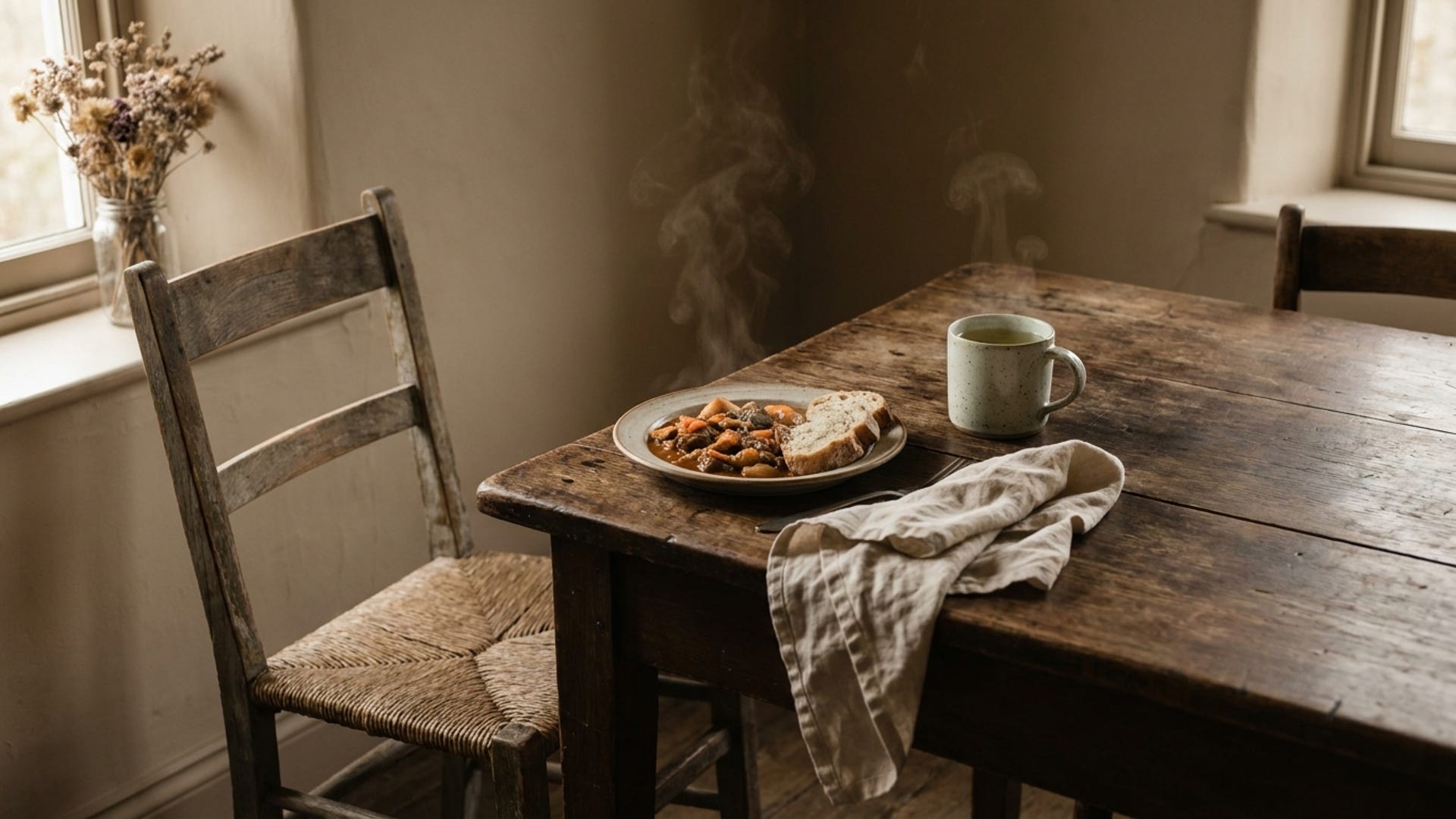
The simplest place to start is with a warm, sit-down lunch. Make it daily, on-time, without screens or books.
Carving out time for this sets boundaries smack dab in the middle of the day when the world demands every part of you.
It’s a rebellious act of self-love and advocacy that will inject your system with earned dopamine.
The sit-down without screens allows your body to stop and enjoy the meal. It will activate your vagal nerve. You won’t find yourself feeling hungry for something else afterwards because you stopped wolfing it down while responding to emails. This shifts you out of grind mode, and you’ll feel calmer, more nourished, and in your own skin.
Warm supports digestion (your body has to work a lot harder to process cold foods) giving you afternoon energy instead of depletion.
Because you’re used to eating in front of your screen, you’ll get bored or start feeling antsy. Following through anyway will start to move you from consumer to creation mode. In this mode, you start hearing your own signals and trusting yourself.
You’ll become self-referred. Instead of filling your days and mental space with other people’s urgencies, you’ll start to make decisions from your deepest values and priorities. You know things, and you’ll start to trust and act on them. You’ll begin to realize you’re no longer exhausted. Or numb.
I never thought I’d find myself writing about lunch. For a while, I left food alone in my coaching, and instead taught how to use meditation as support for one’s life work.
But what I found was that too many will treat meditation like another thing on their to-do list, wonder when it will start working, and then move through the rest of their day on borrowed urgency.
I realized eventually that I myself didn’t start with meditation; I started with a proper warm lunch. I started to feel light, which gave me clarity and energy. My digestive and sinus issues disappeared. I started making choices that moved me forward instead of ones I’d regret or kept me in the grind.
Once my baseline was calmer, I dropped into meditation like an intermediate.
It became easier to do the harder things in life. Curiosity peaked because I wasn’t so dysregulated. And courage to take right action became less traumatic.
I learned the importance of having anchors throughout my day to sustain steadiness and equanimity. To stop looking at streaks and instead focus on a faster return rate. It was a return to love.
The lunch is the doorway. It stops the grind right when it starts to snowball: midday.
But context matters. Lunchtime isn’t the whole picture.
Your morning dread started yesterday at lunch.
Your 3pm crash was set in motion by your morning stack, the coffee you leaned on, the night of stolen hours you never repaid.
The body keeps a ledger, and every override is a withdrawal.
The quickest way that I’ve found to get clear context is to audit your typical day. To write down, not what you want or intend to do, but what you actually do from the moment you wake up to the moment your head hits the pillow.
I call this the Day in the Life Diagnostic.
If you don’t know what you’re looking for, answers still may not pop. It may look like you’re doing everything just fine, without rigidity: slow to wake up because you got to bed at midnight to get stuff done. Coffee after breakfast. A warm lunch. A couple of cookies in the afternoon because you love cookies, they were there, and joy is important. Nothing earth-shattering. Normal.
The problem is when you stay up until midnight and wake up at 6:30 to get the kids ready for their day. You steal moments of zone-out time to somehow rev up enough energy and push that momentum forward for the rest of the day... until midnight. Quiet reactivity disguised as intention exists with every step.
Nothing really stands out as wrong, but something feels off, and that’s the crux of it. The thought of shrugging it off as this is life feels bad. You want a better life. One that is owned. By you.
You’re not the problem. The operating system you’re running is. And it’s not your fault; nobody handed you an owner’s manual for a human nervous system.
The good news is, changing that feeling to a sustainable This is my life, and I’m so blessed doesn’t take anything complicated.
It begins with a warm lunch.
And from there a few more anchors throughout the day that honor circadian rhythms and keep the nervous system regulated.
The obstacle? When you’re used to associating change with complicated protocols, expensive courses, and pills, simple becomes too easy to dismiss as something you do when you have time.
Because you think:
what does this have to do with my to-do list? How’s this going to fix my exhaustion when I don’t have time as it is, and now you’re telling me to sit for lunch?
You don’t need another course. You need lunch.
The rest of the anchors look at the context of your day. Not your life history. Believe it or not, change doesn’t require that. Nor does it need a complex business plan or another organization or productivity tool. You have those already — the software. But you’re trying to run them on distressed hardware. This isn’t luxury. It’s the most foundational next step.
Understand your typical day. It’s that simple.
The Day in the Life Diagnostic helps you to see your patterns the way I’d see them if you were sitting across from me.
It distills numerous coaching sessions into one. It asks 19 questions, and your answers knit together a solid picture of where you’re feeding depletion versus capacity. It taps into your own intelligence to determine where to start first, and what happens next.
Taking it is itself the practice — the first act of self-referral.
One reader wrote me after going through it:
“I just gave this a try and the results made me cry a little. In a good way, as I felt seen and understood and it (you!) showed me the way forward and deeper into myself.”
Having started with a warm lunch, she had noticed herself singing and dancing more. This gave her the impetus to take that next step.
Go through the Day in the Life Diagnostic.
In as little as 7 minutes, you’ll see where your energy goes, what’s working, what’s not, and get insight into your next move.
Paid members get the AI version. Here’s what another reader said:
“The concrete next steps are perfect! Yes, exactly what I can focus on w/out being overwhelmed. This was super helpful and insightful in getting into what needs to be tweaked as well as highlighting what’s working.”
— Savitree
Mindful eating is so tough for the average person. Thank you for writing this timely article.....we need lunch and GOOD conversation should go with lunch if possible. :)
Mindful eating, the biggest challenge for me next to watching something on the TV and not multitasking while I do it. It's hard to just sit and be sometimes, isn't it?