


For as long as I can remember, my father looked stressed. You could see it in his face.
The stress kept him from enjoying much of anything: his own life, the company of the people around him. When we talked near him, the conversation seemed too loud, too much; he couldn’t join it, and mostly he scowled at the chatter, or found something to criticize. I’d grown so sensitized to it that I stopped visiting for a while. I would love my parents from a distance.
When I finally visited, he looked ten years younger. I don’t mean rested. I mean a different face. He still didn’t say much. But I learned he’d taken up Asian calligraphy, and somewhere along the line, his stress had fallen away.
He hadn’t changed his diet. He hadn’t done botox. He wasn’t taking collagen or an anti-aging supplement. He had started making art and was enjoying it. He was practicing presence, and his body responded.
We do the anti-aging things. The antioxidants: blueberries, red wine, the square of dark chocolate. The serums. The water. Staying out of the sun. You read the studies, you bought the supplements, and you keep a quiet ledger of everything you’re doing right.
None of that was what moved for my father.
Because the biggest driver of how fast you age isn’t on that list. It isn’t what you eat or how much sun you get. It’s the operating system you run your day from. And if that system is the grind, you’re aging yourself, at the cell level, faster than any serum can slow you down.
I want to take you inside an actual cell, because once you see the mechanism, you can’t unsee it. And you’ll weigh the pause against the grind very differently than you do right now.
That operating system has a physical address. It lives at the tips of your chromosomes.
The telomere
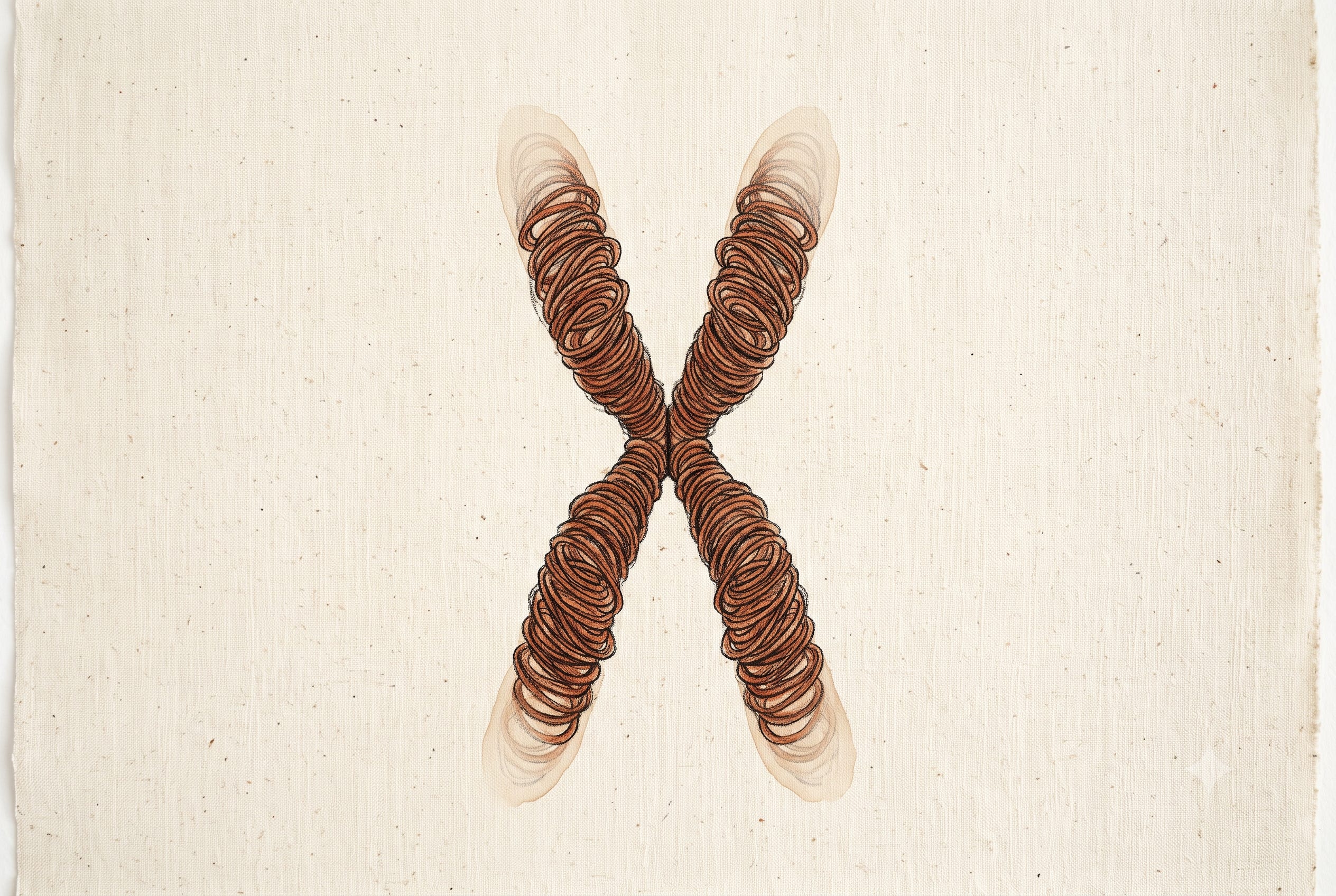
Inside your cells are chromosomes: your DNA, the master scripts that run your organs, your enzymes, your tissues. Unwound, your DNA is about six feet long. It’s wound tight around spool-like proteins, folded over and over into the dense X-shape of a chromosome.
Telomeres are the caps on each tip of that X. Think of the little plastic tips on shoelaces (the aglets) that keep the lace from fraying. Telomeres do the same job for your DNA. They keep it from fraying or fusing when the cell divides. That’s their whole purpose: to be the sacrificial buffer that protects the architecture.
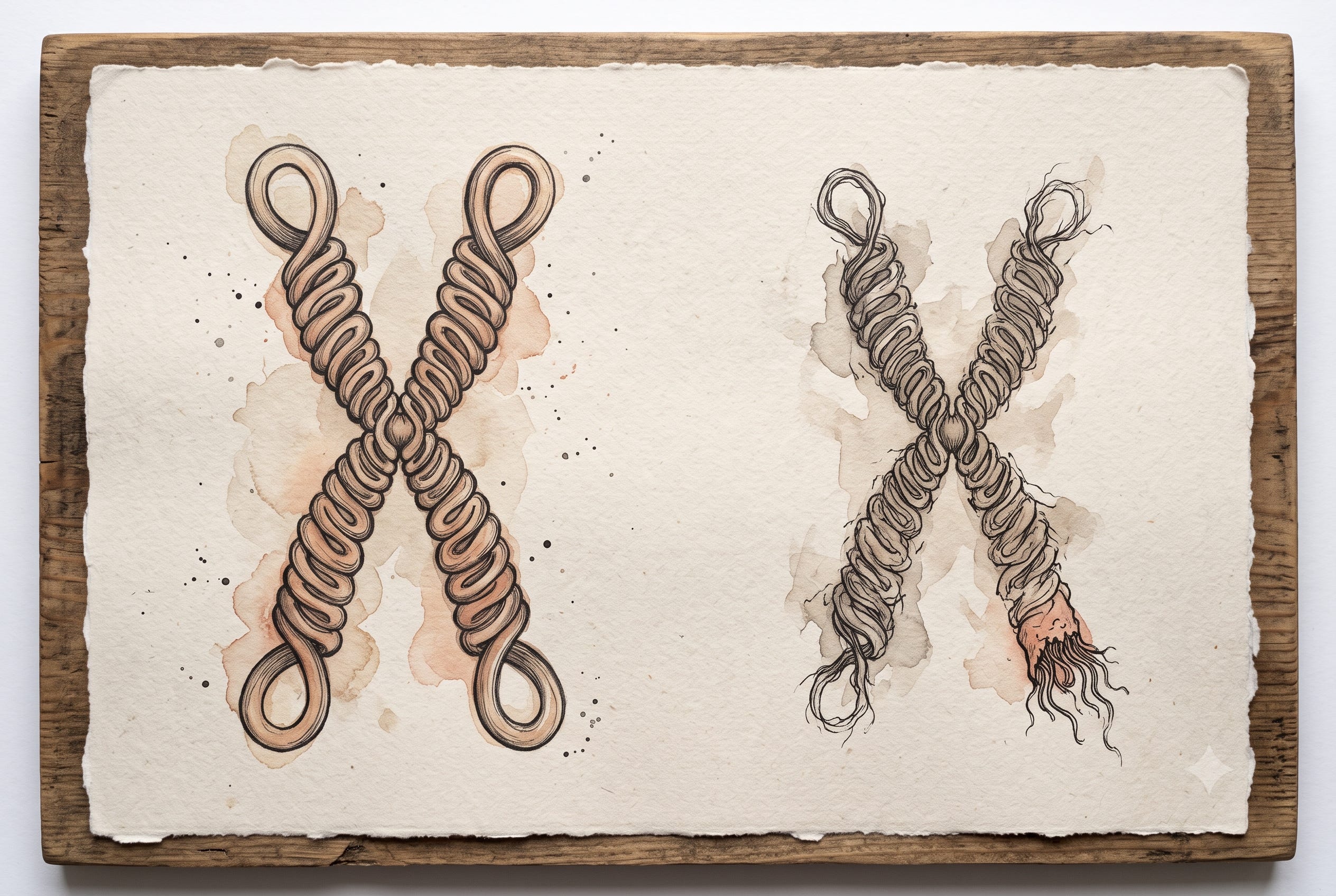
Every time a cell divides, the telomere gets a little shorter. When it gets critically short, the cell either goes into senescence (cellular old age) or it dies.
Telomerase is the enzyme that repairs and lengthens telomeres. You want to keep these online.
What the grind does to it
Chronic stress floods you with cortisol and adrenaline. At the chromosome tips, that flood turns corrosive. The research Elissa Epel has spent decades building shows it behaves like acid on the caps. So when the cell divides, instead of losing the small, clean amount of telomere it’s supposed to lose, it tears off a much bigger chunk. You pay a higher tax on every single division. And the chromosome sends an alarm that changes the fate of the whole cell.
The wear isn’t even. Stress goes after the shortest, most vulnerable cap first. The moment a single telomere on a single chromosome drops below a critical length, it loses its protective loop. The tip unfurls. A raw, frayed edge of DNA is left exposed.
The cell misreads that frayed tip as a break: a catastrophic fracture in the hardware. To stop a broken chromosome from copying itself, it triggers an emergency shutdown. The cell either dismantles itself and dies, or it never divides again. Instead it parks in the tissue and starts leaking toxic, inflammatory waste that damages and thins the healthy tissue around it.
Meanwhile, telomerase (your repair crew) gets switched off. Your nervous system takes it offline because it’s prioritizing immediate survival over long-term upkeep. So the cell is getting shredded harder on every cycle, with zero maintenance allowed in between.
This is how someone in grind mode ends up with the cells of a person ten years older. Not from living faster but from failing to maintain the architecture.
And it isn’t only the low, chronic hum you’ve gotten used to. Sometimes stress is acute: a sudden panic, a sharp boundary violation, an adrenaline-fueled confrontation. That acts like an acid bath. Even when the cell isn’t dividing, it can break the telomeres directly; and if it hits mid-division, a jagged chunk of the cap is sheared off in one shot.
This damage surfaces in a predictable order. Different tissues rebuild at different speeds, and the fastest ones fray first. Your gut lining rebuilds every three to five days. Under chronic stress, it’s the first infrastructure to go. This is why Ayurveda says all disease begins with digestion. Your immune cells turn over in days to weeks, so they age early. Your skin renews about every twenty-eight days and shows the damage fast. Your liver and bones absorb the cost quietly for years, a deep ledger of your choices, before they ever blink red.
Good stress (the kind that heals)
Not all stress shears you. Some of it rewires you.
Picture closing the laptop at noon. Shutting the feed. Sitting flat-footed in front of a warm bowl of soup, completing twelve slow breaths, eating with no screen and no book, while your mind screams this is a waste of time, you’re falling behind!
That friction, that low-grade panic, is real. But it isn’t cellular erosion. It’s the feeling of your nervous system being rewired. When you enforce a boundary like this, you deliberately interrupt an automatic loop. And the moment you finish those breaths and give your body a warm, cooked-food signal, your vagus nerve fires a master override. Warmth and presence prove to your gut that the tiger has been outrun. Cortisol drops. The sympathetic drive collapses. And telomerase comes back online.
The good news
Telomere erosion is not a one-way street. How you operate can raise telomerase activity and stabilize, even lengthen, the caps.
The adjustment has a name. I call it the Effective Pause. Get out of the grind, anchor into parasympathetic safety, and let cortisol drop so the oxidative stress eases. In a word: presence.
And presence is not the same as sleep. Sleep matters, but sleep doesn’t actively clear chronic stress. Anyone who’s slept ten hours through a depression knows that. Presence (parasympathetic activation) is what reverses the trajectory.
Presence also isn’t attending to everything that demands you. That’s external referral, and it erodes presence rather than building it.
The Return Rate
Now for the part that keeps you out of the panic this essay could otherwise leave you in.
Your body is forgiving. It doesn’t need perfection. It needs you to return to presence sooner rather than later. The whole game is your return rate.
Consider the chronic, low-grade leak: the grind as baseline. There’s no explosion, just a permanent low hum of shearing, with telomerase shut down for months at a stretch. The damage is quiet, cumulative, compounding. No one comes to do repairs, because the crew never gets called back.
Now consider the opposite: an intense burst of stress, but a high return rate. Something spikes you. And immediately afterward you manually override, running your anchors: the breath, the warm meal, the pause. The spike collapses. Cortisol drops. Telomerase comes back online, scans the chromosomes, and restores the caps. Your baseline holds.
Same stressful life. Completely different outcome. The difference isn’t whether you get hit. It’s how fast you come home.
Two ways to build presence
There are two I return to, again and again.
Meditation. It teaches you to witness your own tantrums and move through them without reacting: to quiet the replay of the past and the worry about the future, and drop into the only place your signal actually lives. The present. Meditation brings that signal back online.
The warm, sit-down lunch. On time, no multitasking. It teaches boundaries and follow-through, which builds self-trust, which becomes the deep sense of safety you need to live a little dangerously. And it keeps digestion online, which supports every other system downstream.
Yeah, but…
Two objections always come up here. What they are are really two ways of missing the practice.
The first: “I skip lunch and I don’t feel the stress.” That woman isn’t running a resilient engine. She’s cut the wire to her check-engine light. What she calls ‘built endurance’ is her nervous system down-regulating to protect her from burnout. She stops feeling the acute panic of a skipped meal because she’s gone functionally numb. But the tax is still being paid. The telomeres are still shortening, the gut is still thinning, the immune system is still fraying. Her dashboard just went dark. She’s mistaking the clean high of emergency adrenaline for real energy: an unsustainable loan against her future.
The second is subtler. She sits down for the warm lunch, and spends the whole twenty minutes agonizing over everything she should be getting done. Her body is doing the practice, but her mind is still signed into external referral. This is the difference between trying and doing.
Trying is a sympathetic drive. When you try to have a peaceful lunch, your mind treats the meal as a target and keeps scanning for a metric: Am I calm yet? Am I doing this right? Look at the time I’m losing. That keeps you on guard. Your body is sitting, but your nervous system is still running from the predator.
Doing is a somatic fact. You drop the demand for a particular feeling and just execute the mechanics. The jaw chews. The feet press flat against the floor. The breath drops into the navel. That’s presence. Do the mechanics. The feeling follows.
And then it went the other way
Slowly, life kept happening, and my father dropped the art. He surrendered to the stress again, got lost in it, preoccupied by regret and worry. The practice that had brought him back went quiet, and the low, chronic leak resumed. No single dramatic event. Just years of it.
He now lives with dementia, brought on by a stroke. My sister and I are certain (in the way you can be certain about your own father) that he stroked himself out of his own stress.
I watched the same man age backward, and then forward. No supplement did either one. Presence did. And then the loss of it did.
I don’t tell you this to scare you. I tell you because the mechanism runs both directions, and you still have time to choose.
Bottom line
Your chromosomes are live ledgers. When you refuse to install a few daily boundaries, you force your genes to drop their protective caps, and your body makes a cold structural calculation: locking damaged cells into permanent suspension, where they sit in your joints and your thyroid and your brain and leak inflammation into everything still healthy.
Call it what it actually is (instead of “aging”): leaving your repair crew offline while you rush through the day.
The practice is simple: a warm lunch, a few honest breaths, and a short distance between the miss and the return.
Two places to build it: come sit with us live in the Sadhana Huddle, weekday mornings, 6 to 6:30 CDT, or run the Day in the Life Assessment with the AI coach and see your own dashboard, in my voice, before you change a thing.
Your 3pm energy will tell you if it’s working.
-Savitree
Related Essays

The body keeps a ledger

Your cholesterol said stage 5. Your arteries said zero. What the numbers miss and what the body tracks.
The most important date of your day

Daily meditation changed my life. But doing it alone was never the point.
The 90/10 rule: why your rhythm needs room to breathe

You don't need a perfect week. You need a high return rate. And room to breathe when the rhythm breaks.
Wow, Savitree. You’ve taken a complex scientific mechanism and turned it into a deeply human, cautionary, yet hopeful story. We can't always avoid the storm, but knowing that our cellular survival depends entirely on how fast we manually override and 'come back home' to presence is incredibly empowering.
If I had to make a choice between a warm breakfast or a warm lunch, which one is going to be more beneficial?