


I lowered my LDL by 32% in three months. Without a statin.
Conventional medicine says diet and exercise alone will get you 10-25%, depending on adherence and the approach. A 32% drop is what they expect from a daily moderate dose statin, not from oatmeal and kale.
Since I’ve started this 90-day experiment, a few of my clients shared that they too have said “no” to statin, committed to eating “heart-healthy,” and their numbers hadn’t budged. They did what they were supposed to: the salmon, the olive oil, the salad. And it didn’t work. So they went back to their doctor, took the prescription, and that was the end of their experiment.
What they didn’t know was that heart-healthy foods are builders, not clearers. They nourish the heart muscles. They don’t remove what’s already circulating in the blood. If your LDL is high, you don’t need more building material. You need a cleanup crew.
In Ayurveda, these are called lekhana (scraper) foods. High-fiber, gelatinous foods that bind to fats and escort them out of the body. Oatmeal cooked with bone broth. Wakame. Dark bitter greens like kale and spinach, cooked until soft. Mung beans and white basmati rice. Perilla oil instead of olive oil because it has less saturated fat, and it’s a lekhana oil.
Those are what I leaned into for 90 days, and it worked.
Then I broke my foot.
But before I get to that part, here are the numbers.
The before and after
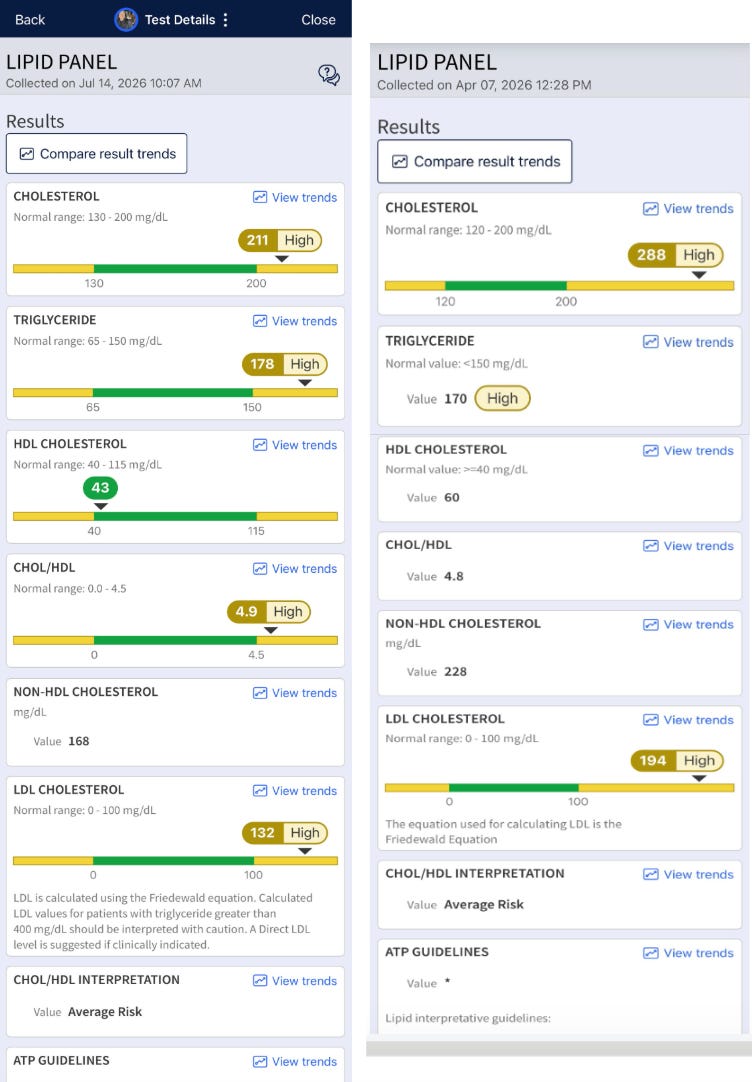
My initial blood test was on April 7. My follow-up was July 15, three months since I refused the statin and started this Food as Medicine experiment.
Lipid panel
Cholesterol – Before: 288. After: 211. Still high, but down 77 points
Triglyceride – Before: 170. After: 178. High, up 8 points
HDL Cholesterol – Before: 60. After: 43. In normal range, but down 17
Chol/HDL – Before: 4.8. After: 4.9. Still high, up 0.1 point
LDL – Before: 194. After: 132. Still high, but down 62 points. That’s the 32%.
Metabolic panel
Glucose – Before: 99. After: 104. High, up 5 points. Normal cut-off range is 99. Everything else from this panel is within normal range.
For anyone who wants a simple map of what these tests mean, here’s the quick guide I wish I’d had:
LDL
This is the “bad” cholesterol number on your lab report.
Think of LDL like trucks carrying building blocks (cholesterol) out to your cells. Too many trucks on the road for too long can cause traffic jams in your arteries.
HDL
This is often called the “good” cholesterol.
HDL is like the cleanup crew. It picks up extra cholesterol from your tissues and brings it back to the liver to be reused or removed.
Triglycerides
These are fats your body uses for energy.
They’re like extra fuel floating in your blood. If there is more fuel than you burn, it gets stored in fat cells for later. Very high triglycerides can be a sign that your system is overloaded.
ApoB
This is a blood test that counts how many “cholesterol trucks” are on the road.
Each truck that can help form plaque has one ApoB tag on it. A higher ApoB means more of these trucks are circulating.
Calcium Score (CAC)
This is a CT scan of your heart, not a blood test.
It looks for hard, calcified plaque in the heart arteries. A score of zero means no calcified plaque was seen and usually points to a lower short-term risk of heart attack, even if your cholesterol numbers are high.
What worked
My LDL and overall cholesterol levels came down dramatically.
Here’s what I ate to make that happen.
Savory oatmeal with spinach cooked in chicken bone broth, finished with fresh black pepper. Kitchari (mung beans and basmati rice) cooked with kale and digestive spices. Basmati rice with wakame and kimchi. Grilled mackerel or baked salmon with dark leafy greens. Fin fish, white beans, tofu, and chicken bone broth were my go-to proteins. I leaned more into perilla oil than olive oil for drizzling. Everything I chose was lekhana. Each meal built to scrape instead of to build.
Is this sustainable? I ate this way while traveling through Korea and Japan. While celebrating birthdays and milestones. While sitting at my mom’s table where Korean moms don’t say “I love you” — they feed you instead.
I honored what I call the 90/10 Rule: 90% lekhana, 10% life. Over the three months, I enjoyed matcha ice cream at the Golden Temple. Wagyu steak in Japan. Korean cookies my cousin gifted us in Seoul. Back home: Chicken wings. Pie. A table of unfamiliar dishes at a celebration for a friend in his 70s who summited the seven highest mountains on seven continents, the final one after 4 attempts! I wasn’t about to miss that toast.
The portions were never over-indulgent, and I went right back to my scraper foods at the next possible meal. The win isn’t to have 0% days. The win is to trust yourself to step back into your 90%. The return rate is the only metric.
What didn’t make sense
My triglyceride and glucose numbers went up, and my HDL went down.
At first glance, this made no sense. I had just dropped my LDL by nearly a third on a clean, natural, unsaturated diet with no medication. There’s no way those numbers should move me toward pre-diabetes at the same time.
On its own, an increase in triglycerides and glucose signals a poor diet heading toward metabolic syndrome. But if that were the case, my LDL would have climbed too. Instead, it dropped 32%, far beyond what’s thought possible.
And HDL? That’s the lipid clean up crew, sensitive to movement and nervous system state. The right amount of exercise and behavioral anchors that calm your system will raise it. I had maintained my anchors, so what happened?
The wild card
Two weeks before my follow-up blood draw, I fell down some steps and landed hard in front of my garage door.
I fractured my fifth metatarsal bone, the long bone in my right foot leading to my pinky toe.
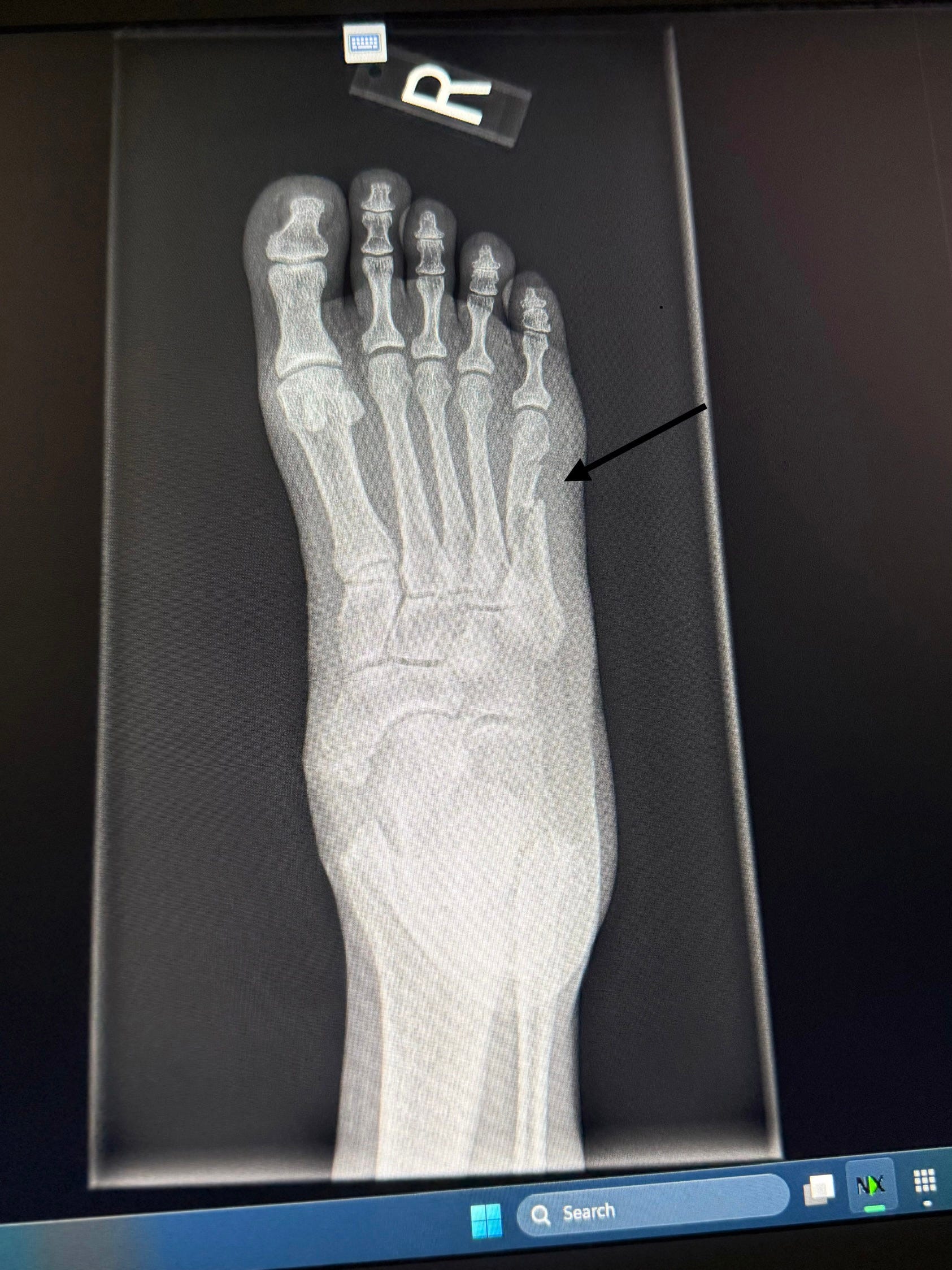
My body entered what’s called Acute Phase Response. It released an acute spike of cortisol to coordinate tissue repair.
When you break a bone, your immune system instantly triggers a systemic inflammatory healing cascade. Inflammation reshapes HDL: levels fall, composition changes, and its normal cleanup functions are impaired.
During acute trauma, the body’s inflammatory healing cascade prioritizes local cholesterol availability for tissue repair over HDL production. Which means my LDL and total cholesterol drop happened before the fall.
Add to this immediate immobilization. I went from a high-activity travel and walking routine to 14 days of absolute stillness and foot elevation. This became the brake on HDL production.
There was administrative friction: doctors, insurance companies, increased dependency. Low-grade stress that keeps adrenaline and cortisol circulating. Cortisol signals the liver to pour extra glucose into your system for immediate, explosive energy, and because I’m not moving after my meals to burn it off, that surplus sugar stayed stranded, forcing the liver to convert it into triglycerides. My 5-point glucose increase is the classic signature of acute trauma, not chronic metabolic decay.
You don’t have to break a bone to trigger stress physiology. Grind state — the chronic low-grade cortisol drip of overwork and skipped meals — will do it. Skipping your walk, your warm lunch, the pauses that keep your nervous system in rhythm: that’s enough to spike cortisol and glucose production on its own.
Moving forward
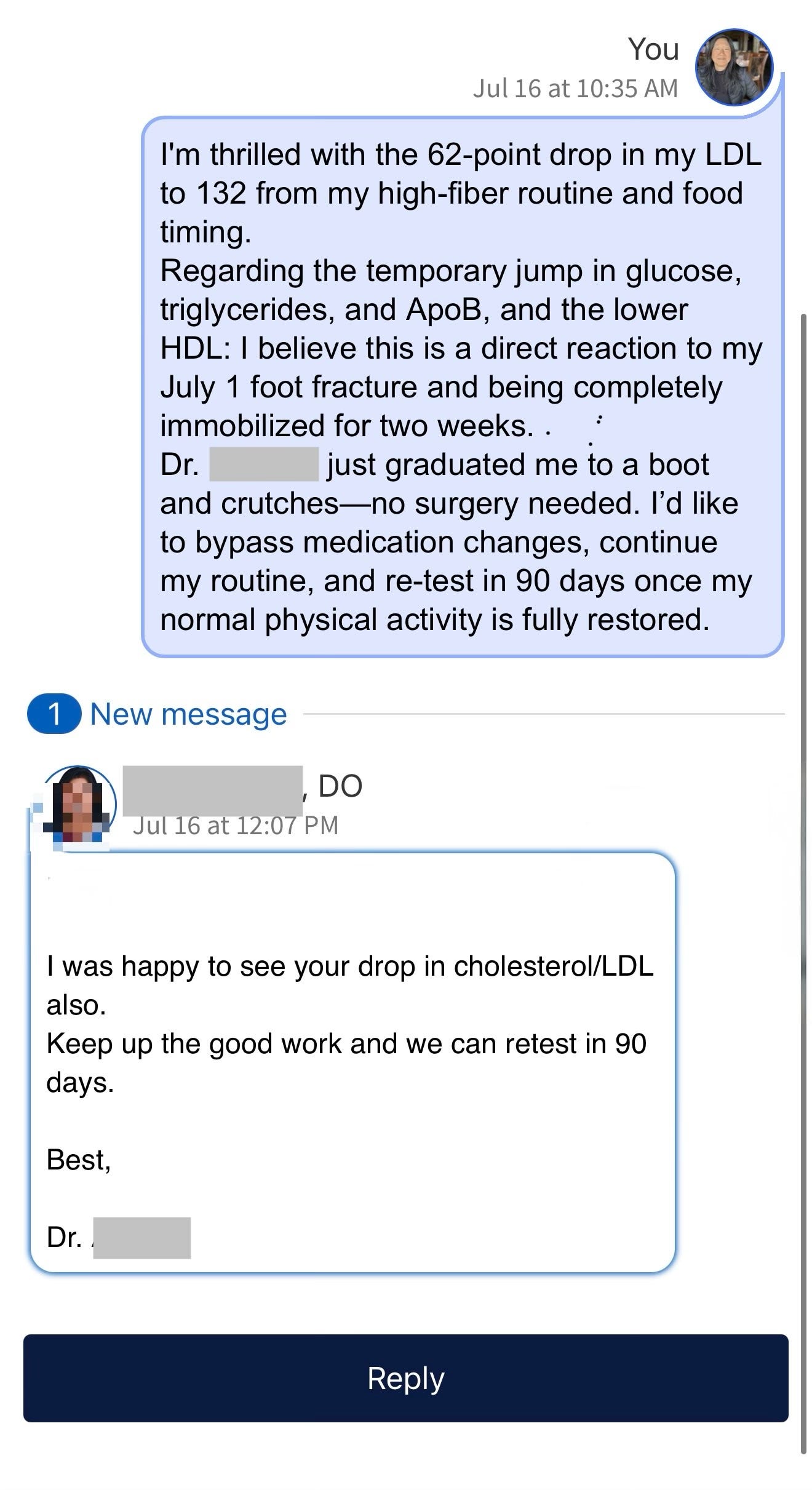
My orthopedic doctor just graduated me from a splint to a walking boot. Over the next month, I’ll gradually learn to put full weight on my mending foot with the support of crutches.
The cholesterol and LDL numbers are remarkable, but those numbers are still high. So I’ll keep eating lekhana foods and finishing my last meal early until they’re within normal range. When that happens, I’ll pivot to include heart-healthy alongside the scraper foods. One builds while the other clears. Both are necessary. Both taste amazing.
The price of the future
This three-month experiment forced me to take a hard, honest look at what I was willing to pay for down the road. Protocol-driven conventional health is a consumer transaction: you check the box, you take the pill, you outsource the management. I decided I didn’t want to add any more unanchored tax to my future.
What started as a rigid, 90-day protocol has become an ongoing rhythm. This was never about willpower or deprivation. It was about operating from my own biological center, which turns out to be incredibly satisfying. When the internal channels are clear, the static drops out of the system, and real body literacy takes over.
Conventional doctors will see a set of isolated warnings: 104 Glucose. 178 Triglycerides. 117 ApoB. They will likely look at those rows and assume I spent my summer over-indulging in processed food and missing my workouts. They may not connect the broken bone in my right foot to the numbers in my blood. Their automated prescription will be an external referral: take a low-dose statin, cut back on carbs, and track your metrics on this screen.
But my 132 LDL proves that my internal architecture was already coming clear before the fall. The 32% drop that conventional math says can’t happen without a drug capsule? That drop belongs to the 90 days before the fracture. My CT calcium score of zero means no calcified plaque and low near-term risk. The arteries are clean.
The data on my report isn’t a disease but a live status update of a brilliant, intact system logging an emergency response to trauma.
Your body is an integrated ledger, not a collection of compartmentalized parts on a lab report. When you stop outsourcing your authority to an app notification or a transactional checklist, you give your internal cleanup crews the exact rhythm they need to keep you whole.
My walking boot is on. My high-fiber scraper routine is running. I’m giving my foot another 90 days to knit, and my liver another 90 days to clear the stress sugar out of the pipeline. Then we’ll run the diagnostic ledger again.
Until then, dinner’s on at 4:30pm with the screen turned off.
– Savitree
Related Essays
The slack ran out

My doctor said my cholesterol was high and reached for the statin. I asked for 90 days instead. This is the exam room scene that started the experiment.
What "heart-healthy" gets wrong

The three-year lipid trend that explained everything. Plus the lekhana protocol: why scraper foods beat builder foods when your LDL is high.
The Ledger

Seven weeks into the experiment, my cholesterol still said stage 5. My arteries said zero. The CT cardiac calcium score and what it means when the numbers and the body disagree.
The body keeps a ledger

Why your doctor assumes you won't change. The six stages of disease assume you will. The philosophy that underpins the whole experiment.
"My doctor prescribed a statin. I asked for 90 days instead." Which is what you do "when you stop outsourcing your authority". This is my biggest takeaway (not the only one!), and it's a solid confirmation that a decision I made 5+ years ago NOT to have my gallbladder removed was absolutely the right one.
My ask was to add some protocols to my routine and then check back yearly. (Actually, I didn't ask the surgeon during the consult. I kinda informed him.)
Every year showed improvement.
The medical system puts alot of pressure on people to do it their way.
You need to know why they're saying what they're saying. You need to know what alternatives are available. You need to know your body. It helps immensely to have a collaborator in the system. My brilliant primary care doc was that for me.
This is excellent, detailed, documented reporting. Thank you.
Conventional medicine does NOT say diet will get you 10% at best. Maybe on average since most people don't stick to dietary changes and the average is dragged down.
Also, lowering LDL levels in the blood does not affect hormone levels or tissue repair. We know this from extreme cases where people are born with very low LDL, ApoB, and LPa. The results? Only some concerns with cortisol and infections, but at an LDL level you could never achieve with drugs.
Great on you for lowering your cholesterol, but no need to trash conventional doctors with lies; especially when you get some cholesterol basics wrong. P.S. We know stress causes high sugar levels.