


Continuation from last week’s essay: The Slack Ran Out
The numbers
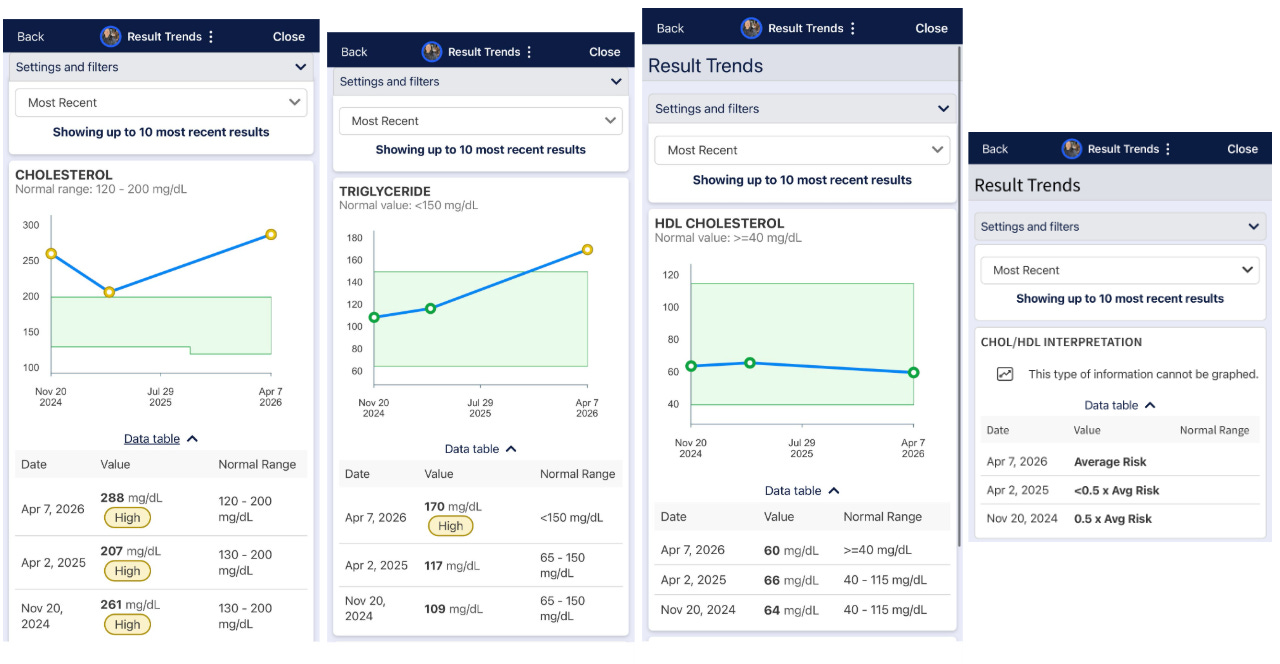
As promised, my blood test results: the lipid panel.
Cholesterol: 288
The V trend here is my “tax bill.”
But looking at the current number alone omits important context, which is why I share the three-year trend.
November 2024 reading: 261
is the result of my 2.5 year experimentation with keto, an attempt to reverse the unwanted effects of my 2.5 year plant-based experiment. Which coincided with the onset of perimenopause.
What I did: reduced meal portions. Took a Red Yeast Rice (RYR) supplement* to carry me through Thanksgiving and upcoming trips to Bogota/Medellín, San Miguel de Allende, Puerto Vallarta/Zihuatanejo, and then Los Angeles over those 5 months. And, I wasn’t feeling the alarm yet to do much more about it (nor did my doctor sound any alarm).April 2025 reading: Less than 5 months later, my total cholesterol dropped from 261 to 207.
What I did: I took RYR for a few more months, then stopped. In November of that year, I decided to experiment with the trending “high protein-nutrient dense” diet to see how it’d support muscle mass and bone density: two things we begin to worry about with age. Increased workout + increased protein (fatty because I dislike the taste of lean protein) = feels great (as with all beginnings). The fact that this diet is socially well supported doesn’t hurt. I didn’t think about dinner timing for this reason.
It felt good. Until it didn’t.My April 2026 numbers reflected this. What I’m doing is below under My 90-Day Protocol.
Triglyceride: 170
This represents how much liquid fat (unused fuel) is in my blood that my HDL couldn’t clean up due to overload (despite increased exercise).
High triglyceride levels (anything over 150) indicate insulin resistance. This is the number most affected by late dinner timing (e.g. being done by 7 to 8pm) along with the keto/high protein experiments.
HDL: 60
This number has been in the 60s (optimal) throughout and represents my “slack”.
While my LDL (194, not shown), is the ‘“trash” currently piled up from my most recent activities, my HDL is the size and efficiency of the “garbage truck fleet”.
At 60, my fleet is large, well-maintained, and ready to work. Meaning, my body has a high capacity for cleanup.
It’s the reason I’m not feeling sick despite the numbers: my system is still actively moving the sludge, even if the volume of sludge (LDL) has temporarily overwhelmed the trucks.
How I got my slack: 21-years of meditation + the four anchors practice. I’ve spent over two decades practicing what scientists call Nervous System Regulation. Chronic stress and high cortisol are HDL killers. By meditating, chanting, and eating a proper lunch (the afternoon mindfulness practice), I’ve protected my liver from the corrosive effects of the stress response. This gave me high baseline resilience.
In my classes, I’ve talked about depositing “money” in your bank account each time you show up for these practices. The HDL is the bank account.
I’m an “Average Risk”: 4.8 thanks to my HDL (buffer). You get this number by dividing total cholesterol by HDL. “High risk” begins once over 5 or 6.
As mentioned in my previous essay, my body was already telling me these numbers were high – in fact screaming at me two months prior, on the flight back from our Mexico indulgence trip: sinuses acting up for the first time in 20 years, constipation, and my natural morning wake-up time slipping from 3:30am to 4:15/4:30.
These body signals weren’t separate complaints. They were the same signal (as the blood tests) – just read through different instruments.
Here’s what these trends tell me: my body responds to change.
*Red Yeast Rice supplement is the TCM version of statin. While still not ideal, it acts more like a “scraper” than a “sledgehammer” (more on this below) working in harmony with the liver’s cleaning “night shift” rather than overriding it entirely.
Why not statin
The liver is responsible for over 500 functions, including hormone synthesis and toxin filtration. Statins shut down the biological factory in the liver that produces cholesterol, a fundamental building block of our structure.
Every single one of our cells has a membrane made largely of cholesterol, keeping the cell walls flexible yet strong. It’s the mother molecule for our hormones, without which we can’t produce estrogen, progesterone, testosterone, or cortisol. And, it insulates our nerves, allowing for the cognitive capacity and decision confidence we so deeply value.
Statins function as an “HMG-CoA reductase inhibitor,” blocking this molecule’s ability to convert into cholesterol. Since produced in the same “factory”, statins also shut down the production of CoQ10, a critical coenzyme for mitochondrial energy production necessary for cell growth & maintenance. Domino effect ensues.
The takeaway: Statins don’t just ask the liver to behave. They occupy the factory. Effectively becoming a “sledgehammer” on the liver.
This is the Viking approach: conquest and intervention.
It works for acute situations. But for someone whose body is sending stage 3–4 signals, the question isn’t whether to silence the signal. It’s whether to answer it.
By relying on statins to manage the numbers, the liver stops maintaining its own metabolic efficiency. It shifts the authority from “internal referral” to an “external” pharmaceutical authority, creating a lifelong co-dependency problem.
I’m not anti-statin. I’m pro-response. There’s a difference, and that difference is sovereignty. Consider the domino effect of the closed factory and, down the line, a kitchen table filled with prescription bottles to take care of each disabled domino.
The missing piece: building vs. scraping foods
Many of you have responded to last Saturday’s essay saying you’ve tried negotiating with your doctors to avoid statin, then surrendered to it because the numbers didn’t move.
There are two reasons why this happens:
You eat “heart-healthy.”
You’re eating at the same time(s) as usual.
Let’s start with point #1: heart-healthy.
Most people who try to avoid statin follow the building playbook:
Eat “clean”.
The numbers don’t move.
The doctor concludes the body isn’t working the way it should.
Truth? Your body is working the way it should. It just isn’t being scoured.
Here’s what you need to know:
Heart-healthy foods are Building Foods.
They’re clean fuel. The bricks and mortar of the body. Excellent for maintaining health. They include lean poultry, broccoli, carrots, brown rice, lettuce, tomatoes, zucchini, celery, potatoes. But they’re stationary:
Lean Poultry (Chicken/Turkey): “Neutral Carrier.” It provides protein without the Saturated Fat Tax, BUT lacks the Omega-3 lubrication of salmon.
Broccoli & Carrots: “Foundational Fiber.” Great for general digestion, BUT lacks the bitter “liver signal” of dandelion or the beta-glucan gel of oats.
Brown Rice: “Stable Fuel.” A better choice than white flour, BUT it’s a “building” starch rather than a “scouring” one.
Lettuce, Tomatoes, Zucchini, Celery: “Hydrating Fillers.” Excellent for volume and hydration, BUT they are too “light” to act as a mechanical broom.
Potatoes (Baked): “Grounding Starch.” A clean fuel source, BUT they provide “bulk” rather than “scour.”
If you have high cholesterol, you don’t need more bricks.
You need a cleaning crew. Foods that scour out the existing debris floating around in your blood vessels. Think kitchen pipes: When there are fats floating around in them, coagulating, it takes scouring.
And with high cholesterol levels, building foods become Accumulators.
Because my 194 LDL and 170 Triglycerides indicate an oversupply, eating building foods (even heart-healthy ones) is like trying to organize a cluttered room by bringing in more high-quality furniture. It doesn’t clean the floor; it just adds to the total density of the room. This isn’t maintenance. It’s further accumulation. The building foods begin to clump with the existing sludge, which led to the sinus venting I experienced on my way back from Mexico.
This is why people get frustrated when they eat “clean” but their numbers don’t move. They’re eating to maintain a body they’re actually trying to scour.
To actively fix the problem, focus on SCRAPING foods.
Dark leafy greens, oatmeal, matcha, radish, miso, kimchi, garlic, ginger, walnuts.
These act as biological detergents that actively scour the pipes.
In Ayurveda, this action is referred to as Lekhana (scraping, thinning, liquefying).
We’ve now moved from basic healthy eating to using Food as Medicine.
Below my signature, you'll find the full scraping reference: the foods, the oils, and why red wine isn't what you think it is.
Next up: point #2
The Arsonist: why timing outweighs exercise
The Viking approach to high cholesterol: work out harder, burn more calories.
While this can help, here’s the downside of this approach: the temptation to overtrain in response to these numbers produces more of the same.
When you overtrain to “outrun” your numbers, those longer, more intense workouts create undue stress on the body causing chronic inflammation and cortisol elevation, which then stimulates the liver to produce more cholesterol.
This “work out harder” approach also doesn’t address when the body is manufacturing cholesterol and why.
The Sage approach: and why timing matters—
Your liver has two shifts (in order of priority):
Processing (digestion): a high-energy metabolically “noisy” event that can take hours to complete
Cleaning (autophagy): requires a quiet, low-insulin environment to perform cellular “scouring.”
When you eat, Insulin (the factory manager) enters the blood to tell the body to stop scouring and start storing. As long as the manager is there, the night shift cleaning crew can’t start their work.
If you eat at 7pm, your liver is occupied with breaking down food until well past midnight.
By the time it finishes, the hormonal window for deep repair (governed by circadian rhythm) is already closing.Which means the cleaning shift never starts. Because as long as there’s elevated glucose in the blood from the meal, the pancreas continues to pump out insulin.
Baseline is reached and the manager goes home when all the fuel from the meal has been successfully moved into the cells or the liver for storage.
Insulin is the switch that tells the liver to manufacture cholesterol, and eating late keeps that switch on all night.
For Building Foods, this can take 5-7 hours.
You can run five miles in the morning and it won’t undo a late dinner.
Because while running vacuum-cleans the glucose from your blood, it doesn’t scour the metabolic sludge that’s already settled in the tissues overnight.
Exercise manages today’s fuel, but only the night shift cleaning crew has the detergent (autophagy) required to clear the existing debt.
Bottom line: the problem isn’t calories. It’s timing.
For Scraping Foods: 2-3 hours.
True story on the power of timing:
Emily (not her real name) shared that she didn’t know she had high cholesterol. It wasn’t high enough for her doctor to tell her. So she went on with her life changing “nothing.”
But she did change something: she decided to start finishing her last meal by 3:30pm. That’s it. Her next meal would be breakfast at 7am.
Her next blood test showed a total cholesterol drop of over 100 points.
Her doctor, of course, asked what changed.
The answer wasn’t food. It was the clock.
My 90-day protocol
Reclaim the early dinner: Finish eating by 5pm.
For dinner, I’m choosing foods that process easily before bedtime: scraping veggies, oatmeal, beans, kitchari.
Exception: dinners out with friends. Schedule dinner as early as possible. Choose scraping veggies when available + grilled or baked fish.Reintroduce Scraping Foods as my daily go-to.
In my monk mode era, I had them every single day, and all my numbers were in optimal range. I slowly moved away from them in my Integration era because Building Foods are what’s usually provided when hosts and restaurants are cooking. Lunch is where I’ll add chicken or fish, and where I may add building vegetables to my scraping veggies. But I have the Scrapers first to ensure I don’t fill up on the rest beforehand.Drink wisely:
- Hot water sips, especially in the morning, to flush everything through my system. As hot as my mouth can take it without burning it.
- Matcha tea in the afternoon. With hot water, not milk or milk alternative.
- Warm to hot water (with or without lemon) throughout the day.Maintain the four anchors as instruments:
- My lunch remains at 11:15 am: warm, on-time, sit-down, and well-chewed for optimal processing.
- 3pm audit: through my energy and clarity levels, this tells me if my system is working effectively (if I’m making the right choices for my body).
- 9pm scan: tells me if I’m going to bed still processing or ready to restore.
- My morning wake-up, the ultimate feedback loop: am I waking up with ease or resistance? Self-referred or externally referred? Just 10 days into my plan, I’m already naturally waking up again at 3:30am, rested and light.Continue to exercise and move my body: Not harder. Just keeping it consistent. Exercise stimulates the muscles to vacuum up glucose from the blood. Overtraining can increase cortisol that leads to higher cholesterol levels.
My exercise routine:
- MWF mornings: 30 min treadmill (incline to 9, speed to 3). 10 min stretching.
- TTh: 22 min full-body workouts with dumbbells. 15 min stretching.
- Daily: 10 min arm swings after lunch (for the lymphatics), then 20 min walk outdoors (weather permitting).
- After dinner: naturally moving activities e.g. going up and down the stairs, folding laundry, putting things away, cleaning up. Movement to allow my muscles to take some of the glucose from my blood.
What I’m tracking:
My energy and general resistance levels as markers for stagnation and flow. Doing this through the four anchors, which sets the rhythm the body needs to deliver the clear signals needed for self-referral.
My weight. Same time, every day. Weight loss can be an indicator for lower triglyceride levels. It can also tell you what foods process well for you.
My numbers: taking another blood test in July. And making my primary doctor my partner. In addition to my TCM. Feels good to have a team by my side.
Portable Sovereignty: What’s Coming
Larry and I leave for Korea and Japan at the end of this month. This isn’t an interruption in my plans — it’s the test.
Lucky for me, Japan and Korea happen to be two of the best classrooms in the world for scraping foods. Miso, natto, radish, kimchi, seaweed — the instruments are everywhere.
The question isn’t whether the protocol survives travel. It’s whether sovereignty is portable. I already know the answer, and I’m excited to live it out in the field.
Here’s what to expect from me:
Instead of full essays, I’ll be sending you shorter dispatches, still using the same Saturday + every-other-Wednesday rhythm. I’ll share things, including how I’m navigating the travel itself and how I’m navigating my plan, holiday style — given that I’m a believer of do as the Romans do, and honoring hospitality (seeing family in Korea).
A word of caution:
Do not try this at home. And by that, I mean, if you’re on medication, don’t go off of it to do what I do. Start with the Four Anchors. Establish Rhythm. Read through the 6 stages of disease from my essay: The Body Keeps a Ledger. Remember: I have over two decades of monk-mode practice, food-as-medicine training, and body literacy behind me — deep reserves that gave me a long leash before the body came to collect. What I’ve been building with you here — the warm lunch, the four anchors, rhythm before protocol — that’s the prerequisite. Without literacy of your own body, even the best protocol becomes just another form of external referral.
If this essay resonated, there are a few ways to go deeper.
Start with The Exhaustion Experiment: a three-day proof of concept to see what one protected lunch changes.
Explore the Library, where the frameworks and tools behind the work live.
When you’re ready for the full system and the witnessing that makes it stick, paid membership opens the door.
— Savitree
FOOD AS MEDICINE:
The Scouring Greens
Dark Leafy Greens (kale, collards, arugula, spinach): High-fiber “brushes” that physically sweep cholesterol out of the digestive tract.
The “Super-Scourers” (dandelion & rapini): Potent bitters that signal the liver to release stagnant bile and flush the system.
Parsley: Not just a garnish! It’s a “vascular rinse” that flushes excess sodium and supports the kidneys in filtering the blood.
The Metabolic Detergents
Radish: A biological “plumber” that breaks up metabolic congestion and clears the pipes.
Miso: Fermented enzymes that support “Agni” (digestive fire) and help process heavy fats.
Kimchi: Probiotic “detergents” that break down sugar and support the gut-artery connection.
The Mechanical Scrapers
Flax Seeds: A mucilaginous broom that binds to waste and ensures a clean, daily elimination.
Beans & Lentils: Slow-burning fiber anchors that prevent insulin spikes and lipid storage.
Seaweed: Mineral-rich sponges that bind to toxins and help remove them from the body.
The Vascular Lubricants
Garlic: A natural vasodilator that prevents “stickiness” on the arterial walls.
Ginger: A metabolic heater that thins the blood and keeps the “cleaning shift” moving.
Matcha: A concentrated antioxidant flush that protects heart health and clears mental fog. (use ceremonial grade, not culinary)
Walnuts: Omega-3 lubricants that “oil” the arterial pipes and lower blood viscosity.
The Arterial Sponge
Oatmeal (Steel-cut or Rolled): Contains “Beta-Glucan,” a specialized gel that mops up excess lipids and keeps the blood light and clear.
Oatmeal works if it isn’t buried under large amounts of brown sugar or cream.
Instead of throwing cold berries on top, cook them in for optimal digestion. If you need more sweet profile, add a tsp of ghee or cook in half a banana. Or drizzle a little bit of honey (but don’t cook). OR, try a savory version: ¾ cup oats, 2 cups chicken bone broth, a handful of dark leafy greens (I like collards), a pinch of salt, black pepper to taste.
I’ve organized this a different way for you:
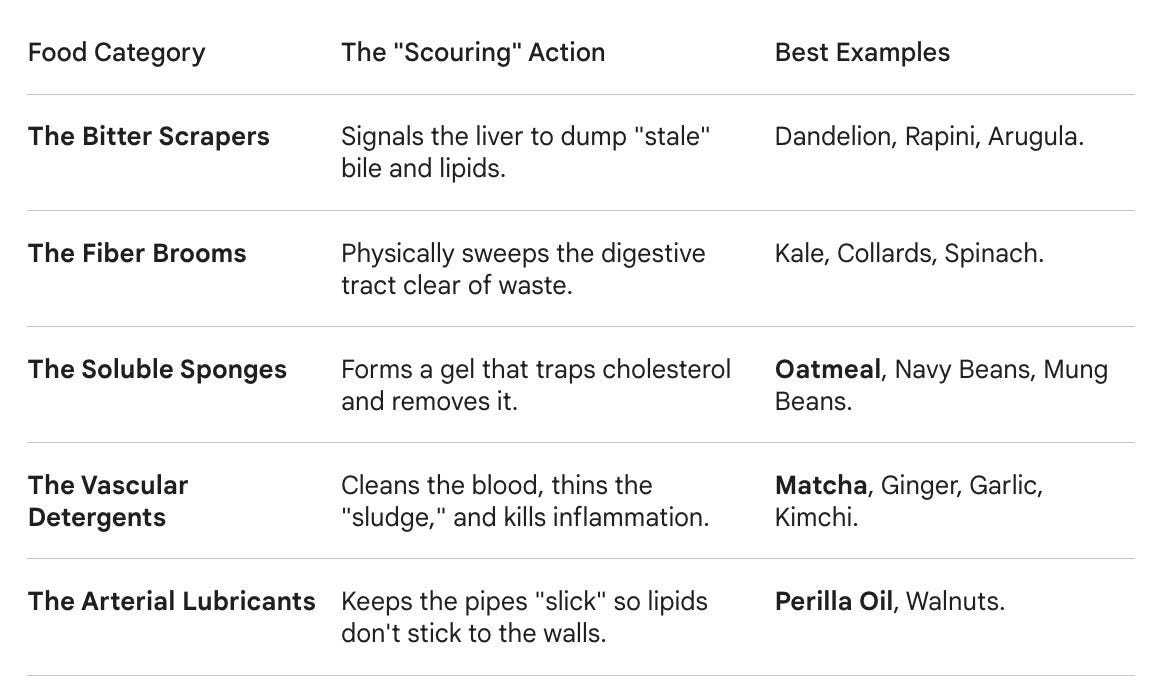
The “red wine” myth: the resveratrol illusion
The Reality: to get enough resveratrol to actually “scour” an artery, you would have to drink about 1,000 bottles of wine in one sitting.
The Triglyceride Tax: for someone with a 170 triglyceride count, red wine is actually “arson.” Alcohol is a refined sugar that the liver immediately converts into triglycerides.
The Verdict: it doesn’t counteract the meat. It adds a second layer of “dampness” for the liver to process during the night shift.
The oils:
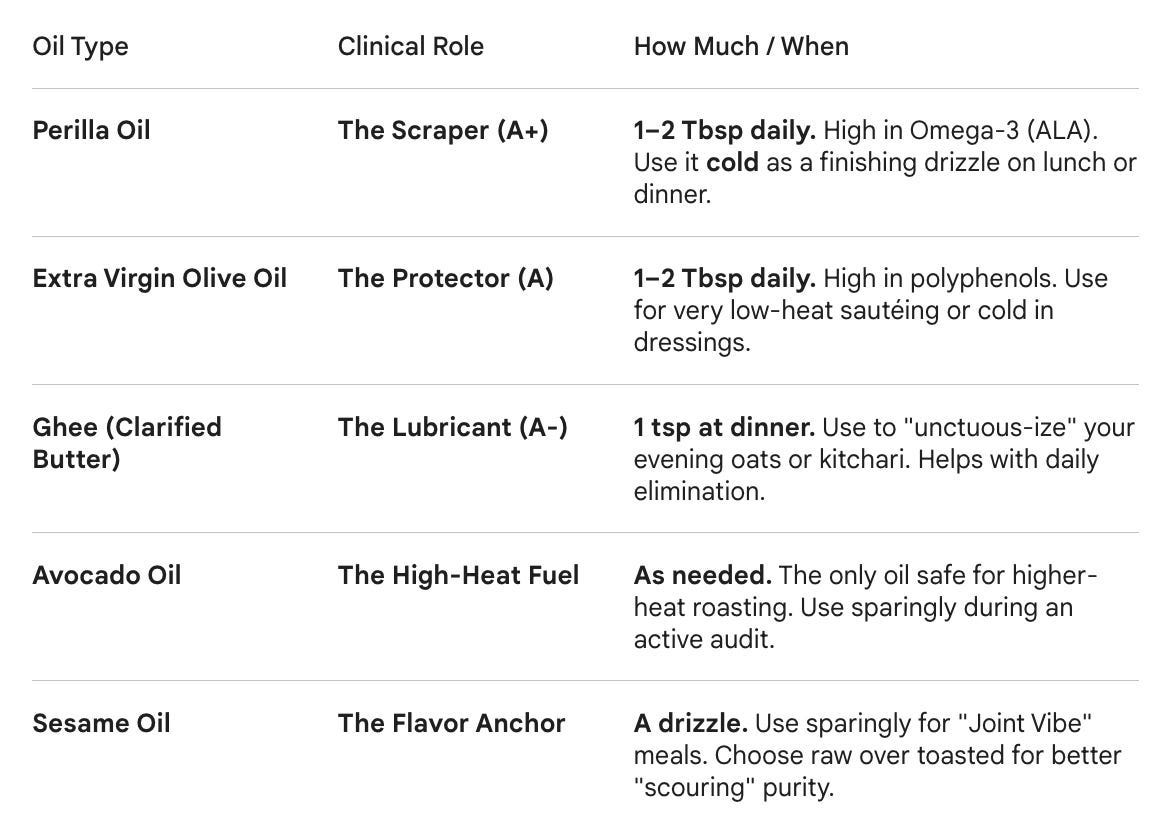
Supporting Bibliography & References
1. The Red Wine “Resveratrol Illusion”
The “1,000 bottles” figure is a clinical benchmark used to illustrate the massive gap between the concentration of resveratrol in wine and the doses used in successful heart-health studies.
Reference: Baur, J. A., & Sinclair, D. A. (2006). Therapeutic potential of resveratrol: the in vivo evidence. Nature Reviews Drug Discovery.
The Data: Clinical studies showing metabolic benefits typically use 500mg to 2,000mg of resveratrol. A 5oz glass of red wine contains only about 0.2mg to 1.0mg. To achieve a therapeutic dose of 1 gram, a person would need to consume roughly 1,000 liters (or approximately 1,300 bottles) of wine.
2. Oatmeal and the “Beta-Glucan Sponge”
Reference: Whitehead, A., et al. (2014). Cholesterol-lowering effects of oat β-glucan: a meta-analysis of randomized controlled trials. American Journal of Clinical Nutrition.
The Data: This meta-analysis of 28 trials confirmed that a daily intake of 3 grams of oat beta-glucan (the amount in one large bowl of oatmeal) significantly reduces LDL cholesterol by interfering with the reabsorption of bile acids in the gut.
3. The 4:30 PM Window (Circadian Metabolism)
Reference: Manoogian, E. N. C., & Panda, S. (2017). Circadian rhythms, time-restricted feeding, and healthy aging. Ageing Research Reviews.
The Data: Dr. Satchin Panda’s research demonstrates that late-night eating disrupts the liver’s “cleaning shift” (autophagy) and leads to higher triglyceride production. Ending the eating window early allows the liver to switch from “storage” mode to “scouring” mode.
4. Garlic and Vascular Stickiness
Reference: Ried, K. (2016). Garlic Lowers Blood Pressure in Hypertensive Individuals, Regulates Serum Cholesterol, and Stimulates Immunity. The Journal of Nutrition.
The Data: This review confirms that aged garlic extract can reduce total cholesterol by 7–29 mg/dL and acts as a “vascular detergent” by increasing nitric oxide production, which prevents plaque from sticking to the arterial walls.
5. Honey as a “Lekhana” (Scraper)
Reference: Noori, S. Al-Waili. (2004). Natural honey lowers plasma glucose, C-reactive protein, homocysteine, and blood lipids in healthy, diabetic, and hyperlipidemic subjects. Journal of Medicinal Food.
The Data: Clinical trials show that raw honey—unlike refined sugar—can actually reduce total cholesterol and LDL while slightly raising HDL, supporting the Ayurvedic classification of honey as a “scraping” agent for metabolic waste.
Savitree, thank you for sharing your journey with us. It’s truly inspiring and motivating. Thank you as well for your practical tips — I’ll definitely be trying some of them. I’m looking forward to hearing more updates from you, and I wish you a wonderful journey!
This was incredibly informative. Thank you for all of the details here!