


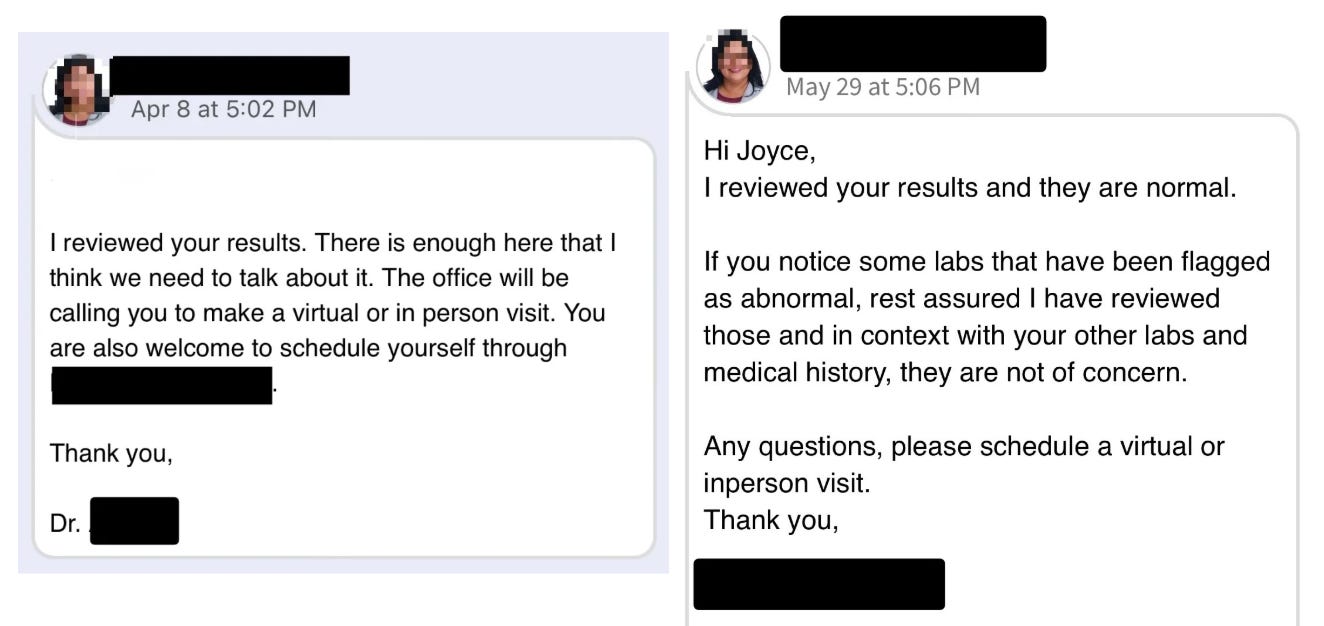
Two messages from my doctor, seven weeks apart.
April 8: “I reviewed your results. There is enough here that I think we need to talk about it.”
May 29: “I reviewed your results and they are normal.”
The first was about my cholesterol. The second was about my heart.
When I refused the statin in April, my doctor offered an alternative: a CT cardiac calcium score. It’s a scan that looks for calcified plaque in your coronary arteries. The buildup that leads to heart attacks. Your score is a number. Zero means no detectable plaque. Higher means more.
I said yes.
Let me be clear: I am not playing chicken with my health, and I am not anti-medicine. Western medicine is brilliant when the crisis is acute. But when a condition is chronic, we have options, and we have time. I choose to take absolute responsibility for my choices.
Life got in the way of scheduling it immediately. I was leaving for Korea and Japan at the end of April. I took the scan on May 27, seven weeks into the experiment.
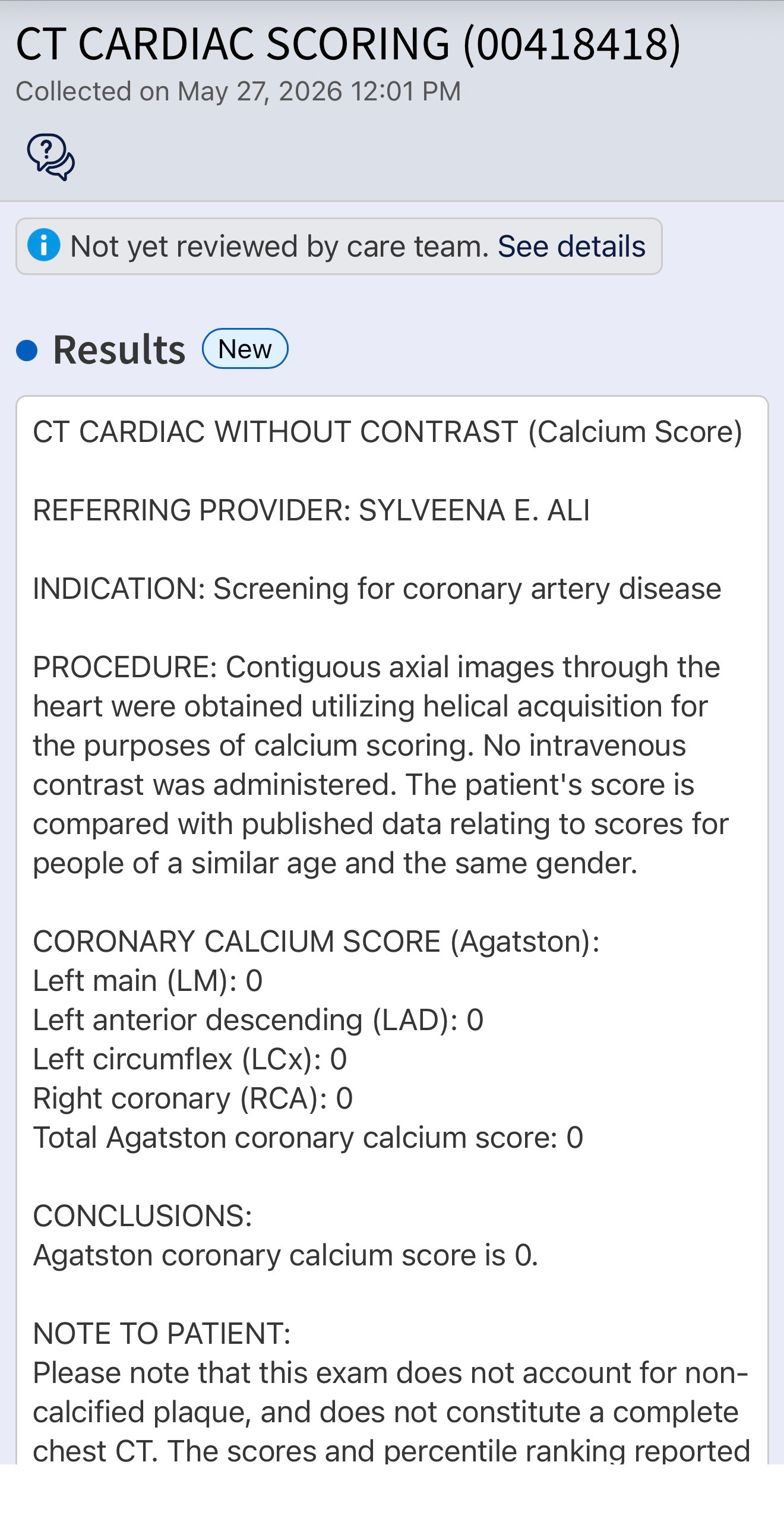
Here are my results:
Left main: 0
Left anterior descending: 0
Left circumflex: 0
Right coronary: 0
Total Agatston coronary calcium score: 0
All four arteries. Zero across the board.
I sat with that for a while.
My cholesterol is high. My LDL is elevated. By the standard playbook, those numbers point toward risk: plaque, narrowing, the slow accumulation that leads to intervention.
But my arteries are clean.
The numbers said one thing. The body said something else.
Here’s the question that kept coming up for me, and I want to be honest about it because when I first saw those zeros, I didn’t have the answer:
Was there plaque seven weeks ago that the scraper foods cleared?
For seven weeks I ate scraper foods: bitter greens, oats, garlic, flax, the full protocol from “What Heart-Healthy Gets Wrong.“ I wasn’t rigid about it. I ate my way through Korea and Japan. I had matcha ice cream at Kyoto’s Golden Temple. I had every banchan dish my family put on the table. And then I came home and returned to my anchors.
But then I went looking for the hard science, and the physiology told me something clearer and much more grounding: No.
Calcified plaque takes decades to harden. Seven weeks of an imperfect protocol cannot dissolve a structural fortress. If my score was zero on May 27, it was zero in April when my doctor first panicked.
A calcium scan only reads the hardened past, the old scars of long-standing damage. It does not see the soft, uncalcified lipid tracking of the present, the circulating debris floating through the bloodstream right now.
And that’s exactly where I realized what 21 years of practice actually built. It didn’t make me immune; my circulating numbers still rose. But two decades of a settled nervous system, internal alignment, and functional agni prevented the systemic inflammation that acts like glue.
Total cholesterol isn’t the sole author of a heart attack. Inflammation is.
Inflammation is the sandpaper that irritates the vascular walls, creating the wounds where circulating lipids get trapped, oxidize, and build dangerous, soft, volcanic blisters. If your blood vessels aren’t inflamed, the cargo doesn’t park. It just floats through the transit lanes.
The slack held the infrastructure clean while the numbers rose. My practice didn’t give me a get-out-of-jail-free card; it just gave me a clean job site to do the real work.
What that looks like in the data:
Most people with my cholesterol numbers would have an HDL around 40. Mine is 60. Same blood test. Same results that triggered the statin conversation. My body’s clearing system didn’t degrade even while the cholesterol climbed. The cleaning crew is strong. Twenty-one years of practice built that crew. The protocol I’m on now is just giving them more to work with.
While that’s not a free pass, it’s a head start.
And it’s why I’m doing this experiment instead of taking the statin: the foundation is still there. The body is still responsive. I’m giving an intact system the right materials: scraper foods, rhythm, and timing.
And btw, when I talk about “scraper” foods, I don’t mean they act like a literal steel-wool brush inside your blood vessels to erase plaque. They work upstream, intercepting the load before it ever reaches your arteries. Spices like garlic and turmeric ignite the digestive fire (agni), preventing food from turning into metabolic waste. Soluble fiber in flax acts like a sponge in the gut, binding to cholesterol-heavy bile and escorting it out of the body entirely.
Two weeks ago, in “The Signal Ozempic Silences,” I wrote about the gap between what a lab report flags and what your tissue actually looks like. My cholesterol put me at a structural risk by the Western framework. But the ancestral map tells a different story: the lipids are circulating, but because systemic inflammation is low, they haven’t been able to park. My arterial tissue is untouched. The invoice is screaming. The ledger is quiet.
That gap — between the circulating data feed and the actual state of the tissue — is the whole argument for why signal literacy matters more than a static lab result. The lab result tells you where the system flagged something. It doesn’t tell you what’s actually happening in your body. Only your body tells you that.
My doctor looked at the scan and wrote “normal.” She’s right.
But “normal” doesn’t capture what I actually learned. What I learned is that the ledger is more patient than the invoice. That the body gives you more time than the medical system suggests. If you’ve been making deposits.
I want to tell you what the last seven weeks actually looked like. Because I know some of you are reading this thinking I must have been monk-mode strict since April.
I wasn’t.
Here’s what I did: I ate warm, on-time lunches on most days. While in Asia, my anchor meal was breakfast. I made scraper foods the backbone of my meals: kitchari, bitter greens sautéed lightly in avocado or olive oil, garlic in almost everything. I protected my dinner timing: earlier, lighter, giving my body the overnight window it needs to do its clearing work.
Here’s what I also did: I ate out in Seoul with family. Bibimbap and japchae and every side dish on the table. I ate soba with herring in Kyoto. Wagyu in my hot pot at a cooking class in Tokyo. The bento box on the flight home.
I came back to Chicago, missed my kitchen, and made spinach kitchari with bone broth my first day back.
The return rate was the practice, not the streak.
Instead of punishing the misses, I shortened the distance between the miss and the return. Some weeks, 90/10 was more like 80/20. But the anchor was always there. The warm lunch. The dinner timing. The morning practice.
And the arteries held.
The experiment isn’t over. July 22 is the follow-up blood test. That’s the original finish line, the day my doctor and I agreed we would look at the data and determine whether the statin conversation reopens.
Before I left for Asia, my Traditional Chinese Medicine practitioner handed me a bottle of red yeast rice, a whole-herb source of the compound from which prescription statins were originally derived. He told me to take it and just enjoy the trip.
The bottle sat in my suitcase, untouched, the entire time I was in Korea and Japan.
I wanted to see what my baseline architecture could do first.
If I ever need a secondary intervention to help manage this lipid load, that supplement is where I’ll turn. It’s a sovereign choice, not a fearful reaction.
But for now, I have seven more weeks.
The question I walked into this experiment asking was: Can I force this external number down using only food?
Essentially, I was treating the lab report like an aggressive bill collector.
The question I’m sitting with now is different: How do I partner with a biological system that has been this patient with me?
I’m still eating the scraper foods. Still protecting dinner timing. Still returning to my anchors after every miss. But I am no longer doing it out of a defensive contraction to satisfy an invoice. I’m doing it to support the cleaning crew already on the floor.
The blood test in July will give us a fresh data feed. It will show whether the circulating lipids have responded to the timing and the bitter greens. I will share those results with you, even if they are messy.
Because the experiment was never about achieving a perfect chart to prove I’m bulletproof. It was about learning to read the ledger.
Four arteries. All zeros. A home base that waited for me to return.
That’s the ledger.
— Savitree
P.S. The standard playbook treats high cholesterol numbers as an isolated billing error: the number is wrong, here’s a pill that corrects it. But the physiology doesn’t work that way. Circulating lipids only become a crisis when they meet inflamed arterial walls. Inflammation is the glue. And the primary driver of systemic inflammation is not saturated fat. It’s a nervous system that never downshifts, a cortisol rhythm that never completes, an operating system that mistakes chronic urgency for drive. Your numbers won’t park if your infrastructure is settled. That’s not an argument against medication. It’s an argument for asking a better question than “what’s my number?” Namely, “what’s keeping the match wet?”
The shift from externally-referred grind to an internally anchored architecture doesn’t happen by reading essays. It happens by changing the daily hardware protocols. We reset the nervous and glandular systems inside the Sadhana Huddle, M-F, 6:00 to 6:30 AM Central (Chicago) time. Go annual to join.
What a powerful share, Savitree. 'The body gives you more time than the medical system suggests if you’ve been making deposits'—that line is gold. Congratulations on those beautiful zeros, and thank you for reminding us to look at the whole ledger, not just the isolated invoice!