

Three days. One protected lunch. See what your own data tells you.
A simple three‑day experiment in what happens when one warm, on‑time, sit‑down lunch gets a protected place in your day.
You already know something’s off.
It shows up at 3pm when the second half of the day starts costing more than you expected. You reach for coffee, a snack, your phone. Something.
Maybe you’re hungry. Maybe lunch was too late, too small, rushed, or skipped.
Maybe you’re tired. Maybe you need a break and food is simply the easiest thing to reach for.
You’ve probably already done a lot of the “right” things. You care about food. You have routines. You’ve read the labels, bought the supplements, downloaded the productivity tools, maybe even built a meditation practice.
And still, the same part of the day keeps getting noisy.
My midday, you’re negotiating with your own capacity.
By 3pm, you’re feeling the consequences.
By evening, you may be wondering where the day went.
I want to make one part of that pattern easier to see: Lunch.
When does it happen? Does it happen?
Are you sitting down? Is the meal warm?
Is it enough? What happens afterward?
The Exhaustion Experiment gives you three days to stop guessing and collect your own data.
The lunch you keep skipping is the data point you keep ignoring
Run the experiment yourself:
Three days. One protected lunch. Your own data.
Cold, late, standing over the sink.
Eaten in the car. Or skipped entirely because the day got busy and you decided you’d push through.
That lunch matters
because it shows you where feeding yourself sits inside the hierarchy of the day.
Every time lunch gets bumped, rushed, absorbed into work, you get information: What outranked it?
What did 3pm look like afterward?
What did you reach for?
How did you arrive at 9pm?
For three days, I want you to change one thing:
Protect one warm, on-time, sit-down lunch.
Give it a real place in the day. Then read what happens.
What you do for three days
For three days, choose one lunch window and protect it.
Somewhere around midday, sit down to a warm, simple meal.
Repeat the same basic conditions each day so you have something useful to compare.
Then check in at 3pm and 9pm.
That’s the experiment.
You’re looking for patterns:
Was I hungry before lunch?
Was the meal enough?
What happened to my energy afterward?
What did I reach for at 3pm?
How did I arrive at 9pm?
Three days won’t tell you everything, but it will give you three days of your own information.
One reader, Julie Lambert, described her experience this way:
It was like taking a truth serum! I got really clear on some emotional issues.
That was her experience. Yours gets to be yours.
What’s inside
You get six simple tools for running the experiment and reading what happens.
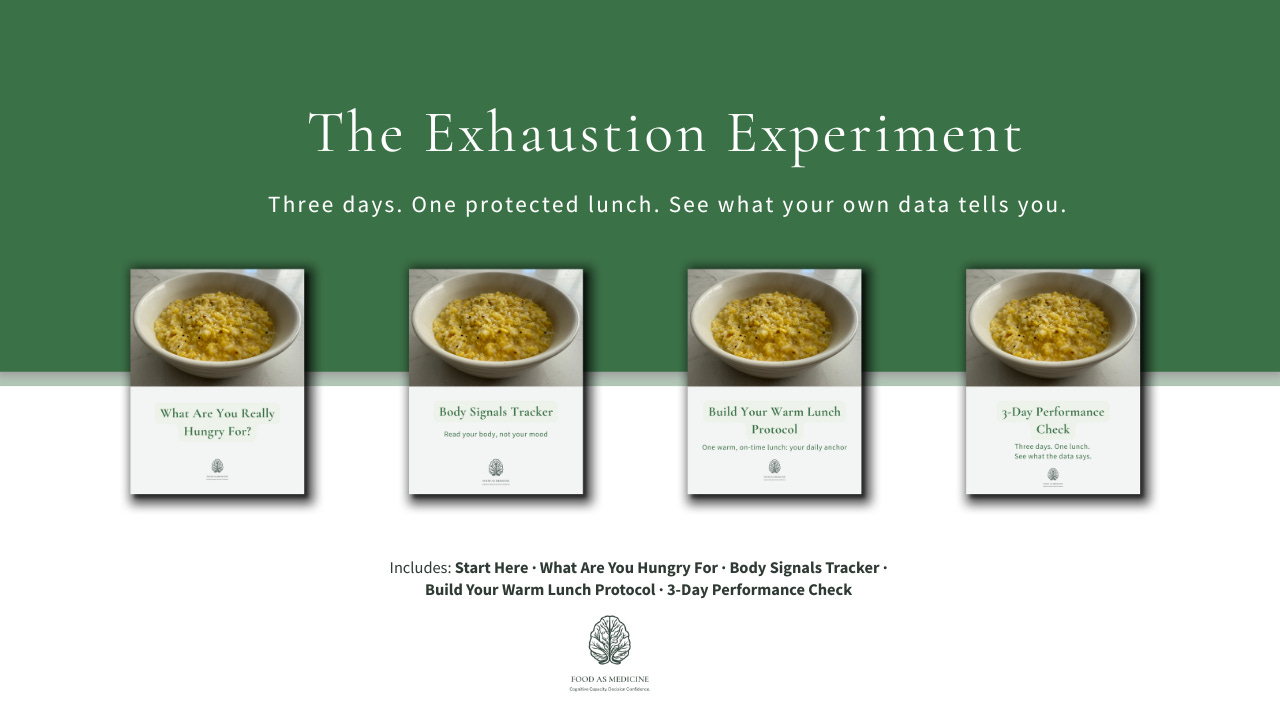
Start Here: Proof of Concept Toolkit
Read this first.
It gives you the three-day structure, the order to use the tools, and the questions you’ll be tracking.
What Are You Really Hungry For?
A reflection tool for the moments when you reach for food and the signal is unclear:
Is it hunger? Rest? Connection? A break? Something you need to say? Something you need to stop doing?
You’ll use this to get more precise about what’s actually asking for attention.
Body Signals Tracker
Your daily record of hunger, energy, mood, body signals, 3pm, and 9pm.
You’re building a record you can look back at instead of relying on how the day feels in hindsight.
3-Day Performance Check
Your meal map for three days.
Warm, simple meals with built-in check-ins so you can keep the variables steady enough to learn something.
Build Your Warm Lunch Protocol
This is what you keep after the experiment.
Choose your lunch window. Protect it. Choose a warm base you can repeat.
Build a lunch rhythm that can survive your actual life.
Bonus: 15-Minute Grocery List
A short shopping guide for making warm, simple meals easier to pull off when the day gets busy.
The goal is less friction between “I should eat” and “lunch is on the table.”
This will probably fit you if
You do a lot.
You’ve been doing a lot for a long time.
You already care about your health and your food.
You’re tired of adding more complicated solutions.
And you’re willing to protect one lunch for three days and pay attention to what happens.
You’ll get the most from this if you’re willing to follow the conditions closely enough to collect useful information.
Warm lunch. On time. Seated. Protected.
Three days. Then read your own response.
Choose a different tool if
You want someone to hand you a permanent meal plan.
You want a weight-loss program.
You want an exact list of food you should eat forever.
The Exhaustion Experiment ends by asking you to make decisions from your own data.
That’s the point.
Two ways to access it
1. Get it inside Food as Medicine membership
Paid membership includes The Exhaustion Experiment, plus the Four Anchors, Personal Capacity Coach, and Fat + Fire.
If you want the Experiment inside the larger Rhythm system, start here:
2. Prefer to own this toolkit by itself?
You can also purchase The Exhaustion Experiment as a standalone toolkit and keep the files for your own use.
Run it once. Read what happened.
Maybe lunch changes more than you expected.
Maybe the biggest discovery has very little to do with food.
Maybe three days simply gives you one pattern you can finally see clearly.
That’s enough. That what the data gives you.
Then decide what deserves to stay.
Eat warm, breathe slow, keep a rhythm.
— Savitree Kaur